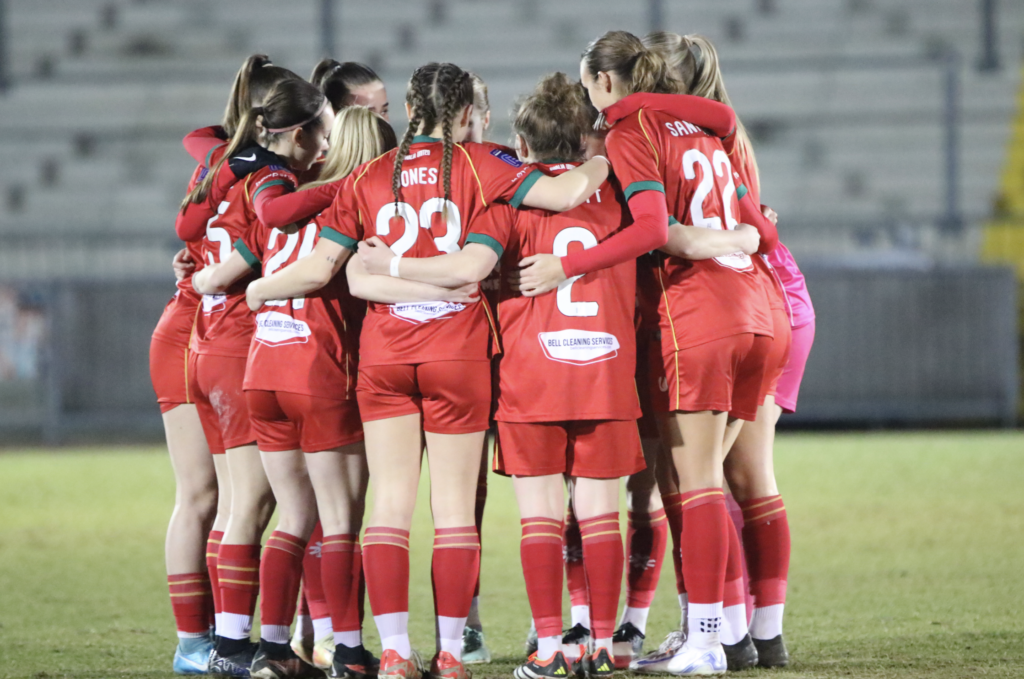
Today, Gwalia United stand as Wales’ most enduring women’s football institution, a club with 50 years of history, whose many names chart a story not of inconsistency, but of survival. From Llanedeyrn L.F.C. to Cardiff City Ladies and now Gwalia United, each reinvention has been less about changing identity and more about ensuring that women’s football in South Wales always had a place to call home.
Now competing in the FAWNL Southern Premier Division, the club’s new crest marks a fresh chapter. Its modern, flower-like design is bold and unmistakably different from the dragon of old, a symbol of renewal, resilience, and unity, qualities that have always defined the team more than any badge. To most, they are simply another name in the pyramid. But to those who know the game’s history, Gwalia are something far more: survivors, pioneers, but also the keepers of a legacy that Welsh football too often overlooks.
Because long before professional contracts, long before the Women’s Super League, and long before the FA of Wales formally embraced the women’s game, Gwalia United, under their many guises, were holding the line.
THE MODERN DAY DRAGONS
Reborn as Gwalia United in the summer of 2024, the name itself feels symbolic. Gwalia is an ancient poetic word for Wales, a word that carries heritage and a national identity too often overlooked.
The club’s owners called it:
“A new chapter for women’s club football in Wales.”
Not just a rebrand, but a recognition of nearly fifty years of history and a declaration of intent for the future.
Cardiff City Ladies, one of the most historic women’s clubs in Britain, had finally reached its crossroads. The new chapter wasn’t a luxury; it was survival. In women’s football, you adapt, or you disappear. As co-owner Julian Jenkins put it:
“Gwalia United is a testament to embracing our future while honouring our storied past.”
That reality is clear to see. Competing in the FAWNL Southern Premier Division is already no small feat for a semi-professional Welsh side. But the real heartbeat of the club wasn’t just the football. It was the people. Coaches heading straight from work to training. Players rushing in from university lectures. Volunteers staying late to shoulder the load of two or three jobs at once. There were no safety nets. No financial cushions. Just the sheer determination of people who refused to let the game die.
That’s the essence of Gwalia. Not only the new crest, not only the stadium move, not even the league table. What defines them is the will to exist, no matter how heavy the odds, and the belief, as their motto says, that this truly is ‘Our Club, Our Nation, Our Story’.
NAMES THAT MEANT SURVIVAL
The club has been called many things. Llanedeyrn L.F.C. in 1975. Cardiff L.F.C. Inter Cardiff. Cardiff County. Cardiff City Ladies. Now Gwalia United.
On paper, it looks like a messy identity crisis. However on closer inspection, it’s the opposite. Each name wasn’t a loss of self, it was a refusal to fold. Another way of saying: ‘we’re still here’. In 2001, an affiliation with Cardiff City men’s club seemed like a breakthrough. At last, the women’s side would share the name and resources of one of Wales’ biggest institutions. Stability, at last. Or so it seemed.
By 2003, the tie was gone. When proposals came down that threatened their autonomy, the women’s team said no. It was costly. It meant standing alone again. But it also meant integrity. They kept the name, the colours, the kit. But the crest told a truer story. No Bluebird. No borrowed identity. Just a red dragon stitched defiantly across the shirt.
That decision defined them for decades. Promotions, relegations, financial droughts, near-extinction, they outlasted them all. In 2006, when they won the FA Women’s Premier League Southern Division, it wasn’t just a football trophy. It was a statement. Welsh women could thrive in a system never built for them.
AGAINST THE CURRENT: A CLUB THAT PLAYED WHEN IT WASN’T AllOWED
To understand why Gwalia’s survival matters, you have to go back further, to a time when women’s football wasn’t just ignored. It was actively suppressed.
When Llanedeyrn L.F.C. was founded in 1975, the FA of Wales offered no meaningful support to the women’s game. Structures barely existed, pitches were hard to come by, and recognition was almost non-existent. Only four years earlier, the English FA had finally lifted its infamous ban that stopped women from playing on Football League grounds, a ban that had lasted fifty years. In Wales, progress was even slower.
That makes Llanedeyrn’s birth remarkable. This wasn’t a football club. It was a challenge to the idea that women should stay off the pitch entirely. What began with a local charity match grew into one of the most important institutions in Welsh football history.
Every time the players laced their boots, they were going against the current. Playing not because they were encouraged, but because they refused to accept exclusion.
That DNA, of defiance and survival, is still stitched into Gwalia United today.
WHY GWALIA UNITED MATTERS
The easy version of Welsh football history is the one dominated by men’s clubs, cups, and internationals. But the true story, the harder, more uncomfortable one, is that the women’s game survived because of teams like Gwalia United. They never had the luxury of wealth or resources. What they did have was persistence. Every rebrand, every reinvention, every volunteer who turned up to carry the load, it all kept the doors open for the next generation.
Without Gwalia, countless Welsh internationals would have had nowhere to cut their teeth. Without Gwalia, young girls in Cardiff and beyond would have grown up with no teams to look to and fewer pathways to believe in. Yet, their story risks being drowned out. They don’t have the glamour of a Women’s Super League side, the media spotlight of Arsenal or Chelsea, or the financial cushion of being attached to a wealthy men’s club.
But perhaps that’s exactly why they matter more. Gwalia United prove that the women’s game in Wales didn’t just materialise when it became fashionable, or profitable. It was fought for. Kept alive in the margins. Protected by those who refused to let it die. That fight, messy, exhausting, often thankless, is the reason there is now a platform for women’s football to grow in Wales at all.
LEGACY AND RECOGNITION
If Lily Parr and the Dick, Kerr Ladies were England’s pioneers, then Gwalia United are Wales’. Proof that women’s football here is not new, not shallow, not secondary but deep, defiant, and unbreakable. When the spotlight turns to Welsh women’s football, the rise of the Adran Premier, the growth of the national team, the push towards professionalism, remember this: there would be no bright future without those who kept the flame alive in the dark years.
Gwalia United are not just another club in the pyramid. They are the bridge between a forgotten past and a thriving future. The keepers of a legacy written in survival, sacrifice, and resilience.
Their story does not just deserve to be told. It deserves to be remembered.