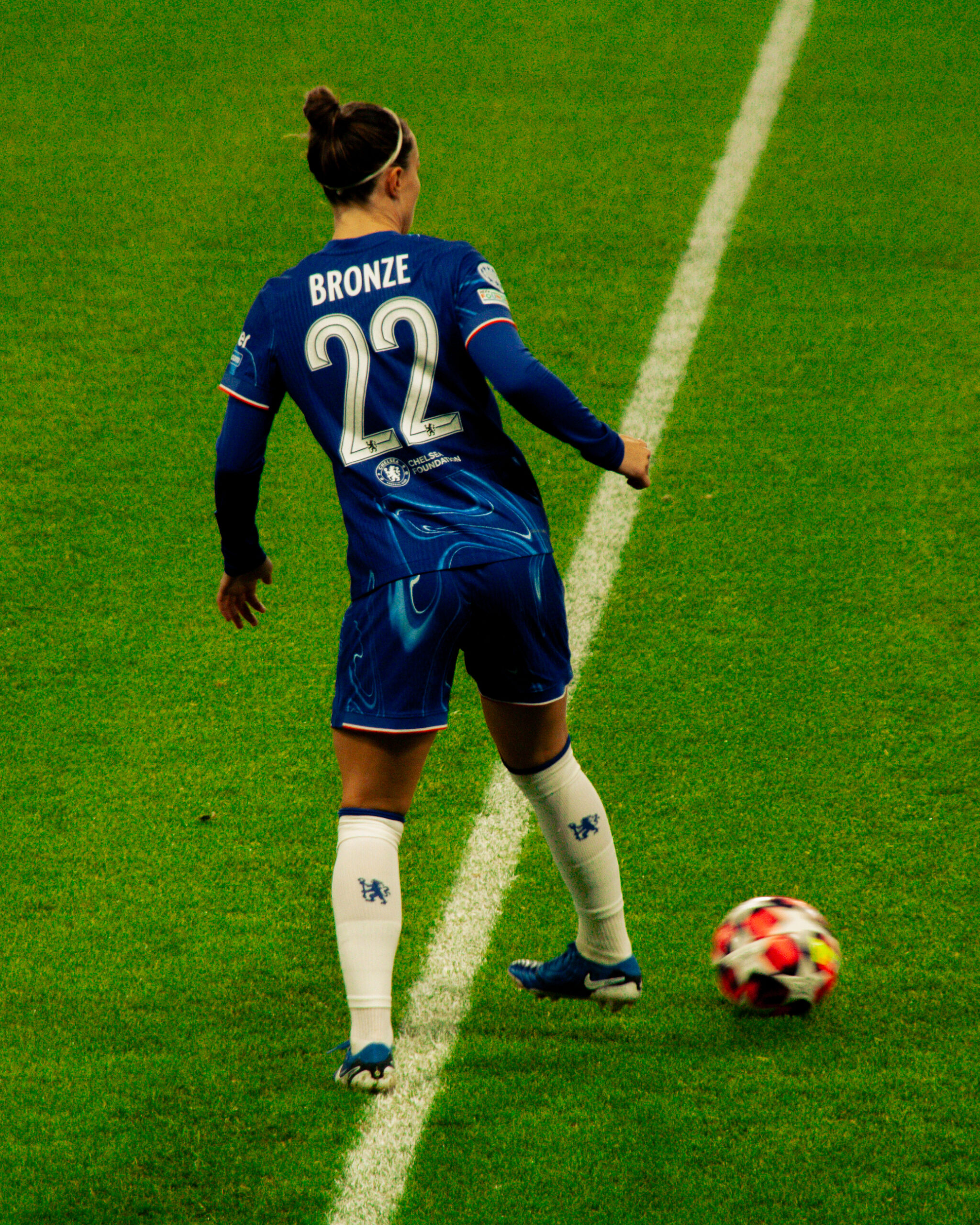
When Lucy Bronze made her debut for Sunderland in 2007, the Women’s Super League was 11 years away from turning professional. Now nearly 20 years after her debut, Bronze has won a scarcely believable five Champions Leagues, two European Championships, nine league titles across three different leagues, and six domestic cups.
In interviews she has recalled that “I had to pay for my kit on a Sunday and things like that.” In Bronze’s early days, to put it simply, the pathways to the top in England for women in football did not exist. Systemic restrictions would not allow it. Bronze herself had to leave England to attend the University of North Carolina in 2009, due to a lack of opportunities to develop in her own country.
Now in the currently age, girls have a vastly improved opportunities to build and nurture careers in the sport, off the back of players like Bronze. Would the next generation of players have the opportunities they do now without the success and longevity of Bronze, her willingness and determination not just to win but to do so in a way where the promotion and progression of women’s football could no longer be denied?
Her individual awards are seemingly endless. She became the first English women to win UEFA Women’s Player of the Year Award in 2019 whilst also picking up honours such as the BBC Women’s footballer of the year in 2018 and 2020, The Best FIFA Women’s player in 2020 and England Player of the Year in 2015 and 2019. Her excellence is so prominent, even the British Royal Family could not ignore it, being awarded an MBE in 2023 New Years Honours.
When names such as Bobby Charlton, Geroge Best and Kelly Smith are brought up, Bronze has more than earned to right to be included alongside them in the pantheon of the greatest British footballers of all time.
Her legacy on the pitch does not fully articulate her accomplishments in football. Bronze has spoken candidly about her 2021 Autism and ADHD diagnosis and how her neurodivergence has helped her become the player she is today. She has subsequently become an ambassador for the National Autistic Society to help raise awareness and to quash stigma. For those who felt their neurodiversity was a barrier to sport, now had the best right back in the history of women’s football as their champion.
Consciousness in Canada
To pinpoint where Bronze’s career, name and influence was established into the public conscious, the 2015 World Cup in Canada was where Bronze truly announced herself to the world on both the national and international stage.
She began the tournament in the midfield, as a result of Alex Scott being a mainstay in the position, in a 1-0 defeat to France. For the next game against Mexico, Bronze displaced the long-standing Scott in her traditional role of right back and shined.
England bounced back with two 2-1 wins against Mexico and Colombia to secure a second-place finish in Group F and set up a round of 16 game against women’s football giants Norway. With the game at 1-1 and entering the final 15 minutes, Bronze knew she had to step up. After some neat passing between Jodie Taylor and her then Man City teammate Jill Scott, the former laid the ball off to a lurking Bronze at the edge of the box.
Bronze then launched a thunderous strike past Norwegian goalkeeper Ingrid Hjelmseth to give England their first ever knockout stages win at the World Cup. In a 2019 interview with FIFA, Bronze herself said the goal and the tournament as a whole “set her career alight.”
England went on to reach the semi-finals of that World Cup, the furthest stage of the tournament the team at reached at that point. It was also a key turning point of the love affair between the English public and the Lionesses. Bronze and the rest of the squad became household names, a new phenomenon for women’s football in the country.
Their influence was instantaneous. The following month’s FA Cup Final between Chelsea and Notts County drew a record attendance of 30,710 whilst being played at Wembley for the first time since 1993. The game did especially well with TV audiences too, seeing a peak audience of just under 2 million viewers. It was a new dawn for women’s football in England and Bronze was at the forefront. Girls up and down the country could now dream that football was for them.
Foreign Excursions
Although Bronze was far from the first English star to play abroad, with players such as the aforementioned Smith and Scott taking their trades stateside during their careers, Bronze did so with such accomplishment that she altered the perception of English women’s football abroad and inspired others to follow in her footsteps.
When Bronze joined Lyon in 2017, the French side had become the premier dynasty in women’s football, boasting players such as Wendie Renard in defence as well as Ada Hegerberg and Eugénie le Sommer in attack. So, with Bronze now firmly established as the best player in her position, it was poetic that she joined the best team in the world.
Although it has become hackneyed to delve into her success at the French club, her achievements are nothing short of staggering. Three Champions Leagues, three Division 1 Féminine titles and two Coupe de France Féminines. A cavalcade of trophies.
Unsurprisingly her time at Barcelona was also trophy laden. A further two Champions League titles coupled with two Liga F titles and a Copa de la Reina to boot. But arguably, her biggest impact was the change in mentality to English players abroad.
Her England teammates were inspired by her escapades abroad. Kiera Walsh joined Bronze at Barcalona in 2022 whilst Georgia Stanway moved to Bayern Munich in the same year. Then England goalkeeper Mary Earps also took the overseas plunge, joining PSG in 2024. Bronze had made English players playing abroad not only viable but encouraged.
Bringing football home and keeping it there
Another international tournament was on the horizon for Bronze and the Lionesses. The 2022 European Championships, which took place in England, gave the national team a massive opportunity to win their first major tournament. Under Sarina Wiegman, Bronze started every game and scored against Sweden in a 4-0 victory in the semi-final. In the final against Germany, the Lionesses finally brought football home, capturing a historic European Championship. After many senior international tournament disappointments, Bronze finally had an international trophy to go alongside the plethora of domestic achievements.
Following the tournament, the establishment could no longer ignore women’s football. In the wake of the Lionesses triumph, the government assigned £30 million to “build approximately 30 new state-of-the-art 3G pitches and accompanying facilities. These sites will be designed to prioritise women’s and girls’ teams across England.”
It would have been the easy option for Bronze and England to rest on their laurels, content with the knowledge that the future of women’s football had been secured in the country. But that would have contradicted Bronze’s mentality.
England headed to Switzerland to defend their European Championship in 2025. The tournament could not have started worse. A 2-1 defeat to France put the holders on the back foot from the beginning. But the team rallied, producing conclusive wins against The Netherlands and Wales to qualify from the group.
Although it was an unlikely opinion to think otherwise by this point in her career, Bronze proved during the knockout stages why her greatness is undeniable. She got England back into the game against Sweden, heading home at the back post following a trademark burst forward and scored her penalty in the ensuing shootout to send England into the semifinals.
She started in England’s semifinal victory over Italy and final victory against Spain to claim England’s and Bronze’s second European Championship. After the tournament, she revealed that she had played through a broken fibula. One of the defining images of that tournament was Bronze taping her own leg during the Sweden match, the perfect distillation of her as a player. An unshowy determination and commitment to win. The Lionesses rise to be arguably the most successful international side in the history of British sport is in tandem with Bronze’s rise to the top of football. When summarising Bronze, Wiegman put it best:
“What defines her is that resilience, that fight. I think the only way to get her off the pitch is in the wheelchair.”
https://www.theguardian.com/football/2019/nov/08/lucy-bronze-interview-england-germany
https://www.gov.uk/government/news/lionesses-trailblazing-success-recognised-with-30-million-fund