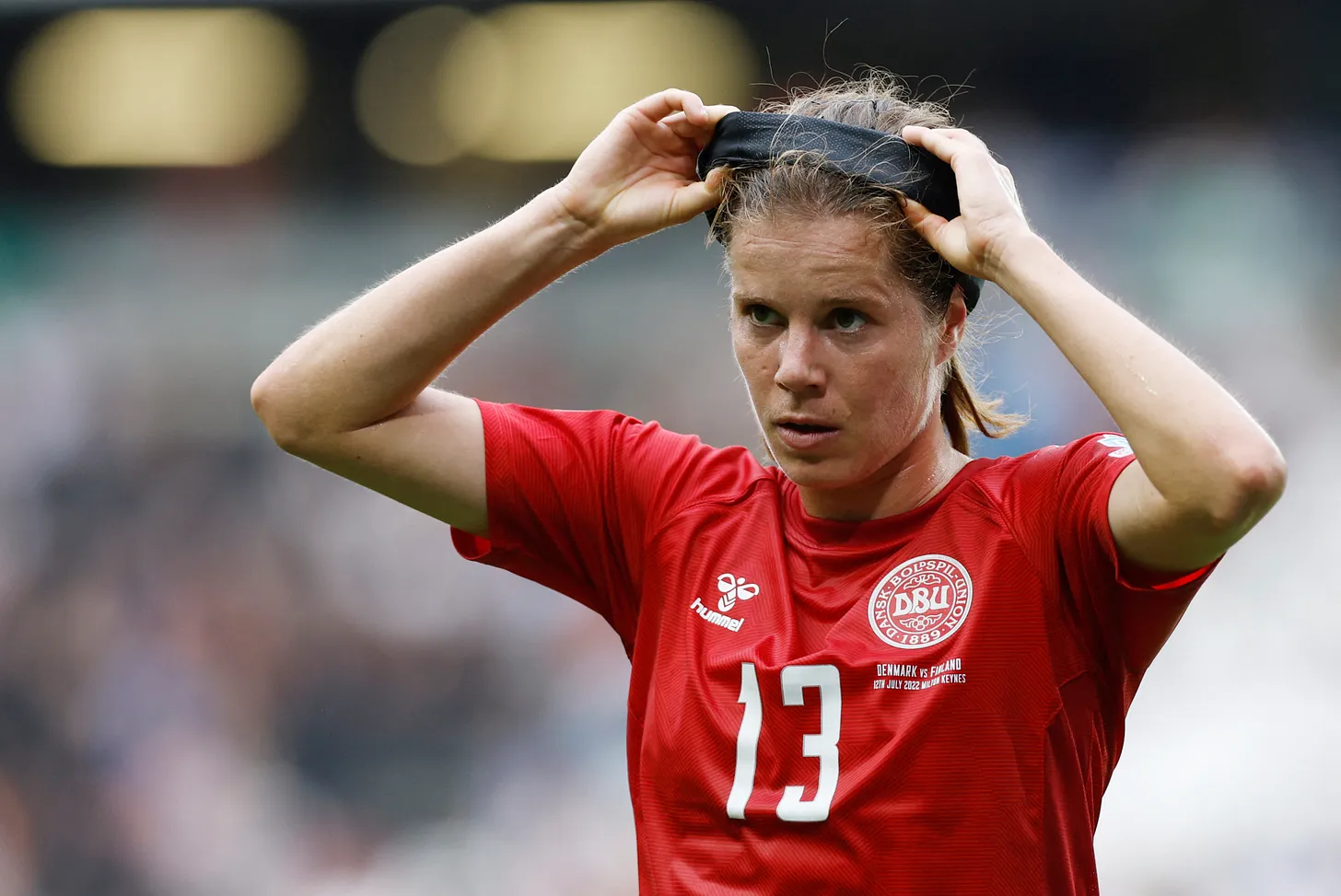
A year ago, Danish international Sofie Junge Pedersen and over a hundred other professionals wrote an open letter to FIFA condemning their recently announced partnership with Saudi Aramco. A few weeks ago, I was fortunate enough to speak to Sofie and got to ask her directly why it was such an important issue, and among other things discussed the idea of women’s players being activists and what issues could arise as more money seeps into the women’s game.
When you were growing up, what did you want to do with your life, did you ever consider professional football an option?
I remember from when I started actually playing football, that I wanted to become professional football player and play for the national team. I can see that in those friendship books, where you give it to a friend and then they can write: what do you want to become in the future? I have written a professional football player.
When I got older, I could see that it was possible, but not for so many. I got my first contract when I was 18 years old. I think it’s earlier now, and I’m happy to see the development. I wish I was 15 years younger so I could experience everything again. There are much more opportunities in clubs to become a professional football player and that’s great to see.
You’ve been involved in a few different groups raising awareness about climate breakdown, what drove you to do this?
From when I was very young, I have been interested in society and politics. I think when it comes to climate change, it started around 2009 when we had the COP 15 meeting in Copenhagen. I think there was so much attention around that meeting in Denmark. That was the time when I realised ‘okay, this is really, really serious.’
What triggers me the most is how unfair the climate changes are. They hit all of us and of course, but some are hit harder than others. It’s often the most vulnerable and least responsible countries, like countries in Africa, for example, are hit very hard, even though they have like tiny responsibility for climate change.
I think this is so sad and so unfair; and that’s mostly what drives me in trying to do something. I read articles about people suffering for example having lost all their cattle, and how they can’t cultivate anything because it’s too dry, or too hot, or too flooded. I think it’s important that we remember that this affects real people on the ground.
Moving onto the open letter which you co-authored, it was specifically challenging Aramco’s sponsorship of upcoming FIFA, including the 2027 World Cup. What problem do you have with this partnership?
First, that it’s an oil company. It’s the world’s biggest state-owned oil company. We know Saudi Aramco is very much responsible for the impacts of climate change that we are we are seeing now. The United Nations (UN) have criticised them a lot for this. I don’t think an oil company is something that FIFA, the football world and we as players should promote.
FIFA has climate policy which acknowledges that climate change is a huge threat to football and that FIFA has to be part of the solution, part of trying to reach the Paris Agreement. I think this is really contradictory, making the sponsorship deal ever with Saudi Aramco. Playing with Saudi Aramco on our shirts and promoting it in this way is not something that I think is okay.
The other part is that it’s 98.5% owned by the state of Saudi Arabia. The Saudi authorities are responsible for serious human and women’s rights violations. Again, that’s something that we as women and football in general should not promote.
FIFA has a human rights policy, where they want to promote and protect human rights around the world. So, it is again contradictory what they say and how they act. We (the open letter) mentioned a lot of women who are in prison just for speaking up about human rights and women’s rights, with sentences of decades in prison. We’re seeing that people are being tortured or even executed for using their freedom of speech to speak up peacefully about human rights.
Also, there’s still a guardianship system in Saudi Arabia where a male guardian can send a woman to a detention centre if he thinks that she has acted disobediently. This is just to mention a few, because when I’ve dived into it, there are so many human rights violations going on. We really just want to be on the Saudi people’s side.
Do you think that consciousness around these issues is bigger in the women’s game?
Definitely. I think it’s in our DNA to be activists. I think most of us have been fighting for equal rights throughout our whole career’s. Getting the same facilities and conditions as boys and men. It’s always been a topic for us, that we have to push for changes. That’s why I think it comes more natural to us. I think also that’s also why we can’t accept being used as female football players to cover up for violations against women and people in general.
Where do you draw the line between accepting any money which allows women’s football to be professional – and all the benefits which that brings to women globally, and questioning whether that money is coming from situations that harm people and women across throughout the world?
I do think it’s important to see how you earn your money. I think that’s very basic or should be very basic for all human beings, that the way you earn money can’t harm others. As football players, we can’t accept money in the short run, and then that money in the long run will destroy the future of football.
When it comes to the human rights part of it, I think it’s very important that we don’t harm the people of Saudi Arabia. And I’m talking a lot to Lina Al-Hathloul, who is a very prominent human rights activist from Saudi Arabia. I have noticed that she says ‘we will not forgive you if you just take our money and turn a blind eye to the violations that are going on in our country.
Given everything we’ve discussed, do you think that if a World Cup or other major event was held in a country that has human and women’s rights violations, it would be boycotted and disrupted in a way that the 2022 men’s World Cup in Qatar wasn’t?
If today we were going to play a World Cup in Saudi Arabia, I think we will hear women like myself speaking up about this. It’s important to say that it’s not because I or others don’t want that sport come to Saudi Arabia, we are happy to see that there is a football league now in Saudi Arabia, but we just can’t turn a blind eye to the brutal things that are also going on.
So that’s why we have to be open about this. We can’t cover up for violations, and I think it’s especially important in a country like Saudi Arabia where people are being muzzled -they are not allowed to speak up and criticise the authorities. That’s where it’s really important that we become the voices of the people there and tell the world that this is what’s going on.
I really wish that the World Cup to be held in 2034 in Saudi Arabia will make changes, because we saw in Qatar that things were not changing. I remember when the World Cup was given to Qatar, that I was happy that ‘oh, it will bring peace to the Middle East and human rights to these countries.’ But unfortunately, that’s not what we have seen. So, we need to change things, to actually make sure that football makes a difference in all countries in a positive way.
Having been through university yourself, do you think the lack of guarantees for professionalism means that women are more likely to seek out this type of education, and then as young players begin to get security earlier could this trend reduce?
I have studied politics and I don’t know if I hadn’t studied politics and been so interested in international politics whether or not I would have been part of a campaign like one against the FIFA. I do think that because there is still a lot to fight for in women’s football, that we will still be open to look at these things and protest if needed.
Part of the campaign we did last year was also to enlighten our fellow colleagues to what is going on. Then many were part of the protest. I think as it gets easier to get a contract in the future, there will be more money in women’s football and then we will also see fewer people go into higher education.
But I still think we will see many doing some kind of education on the side, adapted to the football calendar of course. For me, it’s been very nice to have something on the side. So I think we will still see it, but maybe a bit less.
What would be your response to people who say that sport and politics shouldn’t mix and questioning how climate change is relevant to football?
We have always seen a lot of evidence that football is affected by the climate change. Games are being postponed or cancelled due to extreme weather, we already see that on the professional level, and also at the grassroot level.
At the moment I’m working with a project in Ghana where I mostly work with girls playing football and I have seen the pitches that they are playing on, and it’s just not easy when you play on gravel. Of course, if you don’t have so much water in an area, you don’t use the water to make a grass pitch.
There are just so many places where it’s already impossible to play football or very difficult and of course that’s a threat to football. Both for normal people but also if you want to develop players for the professional level that all of us enjoy watching, it will be more and more difficult.
We in the football industry have a responsibility to do something and a unique power to enlighten people. Also to change the industry itself, to become more sustainable. There is a lot of money in football industry, so there’s no excuse for not being sustainable I think. We have the power and definitely the responsibility to be part of the green transition.
What can readers do to get involved with the things we’ve discussed today?
There are different organisations that work to kick fossil fuels out of football and there’s also an organisation that have made a petition for football fans, that they can sign in support of the professional players letter to FIFA.
There are also different initiatives where people can sign and put pressure on organisations like FIFA. That’s one way you can be heard, also be part of the debate about this, speak up about human rights and climate action.
There are so many things you can do to change your own carbon footprint. Eating less meat is an important way and flying less, buy second hand clothes instead of fast fashion. If you have a pension fund, make sure it doesn’t invest in fossil fuels. If you invest in stocks, there are stocks out there that work for sustainability. Support organisations that work for climate action and human rights. We really need every everyone to do something, everyone that can.
What’s your final message?
I think understanding that climate change is really serious, that’s very important. Also, to have hope that we are actually able to make the green transition and mitigate the impacts of climate change, but we have to move fast. That even though we do hear about improvements in Saudi Arabia, unfortunately in some areas it’s going in in the wrong direction. People are afraid of speaking up because they risk being sent to jail or tortured or even executed.
When that’s the case, we have to be their voices, us who do actually have freedom of speech. Then finally, we need everyone in this fight for both the climate and the human rights. Even though one person can’t change everything, you can still do something.
With this interview, Sofie Junge Pedersen exposes the problems with FIFA’s partnership with Saudi Aramco – it directly opposes FIFA’s own policies. It’s a stark warning that investment in the women’s game is not always good for the game, and that we should be careful to avoid chasing too much financial game at the cost of what makes the women’s game so powerful and unique.
‘Success’ doesn’t need to be an exact replica of the men’s game, which is full of a myriad of issues itself.