On reflection, 2025 was a remarkable year for women’s football on both ends of the spectrum. The European Championships signposted women’s football’s rapid accession, Arsenal defied all odds to win European football’s most coveted prize while their London rivals Chelsea continued their domestic dominance. Away from the pitch, the sport continued to embed itself in mainstream culture.
The appearances of Alex Scott and Karen Carney on I’m a Celebrity Get Me Out Of Here and Strictly Come Dancing respectively, represent a growing wave of women’s football stars becoming household names. On the pitch, Hannah Hampton and Chloe Kelly were recognised for their achievements with the Lionesses and their clubs by being nominated for the BBC Sports Personality of the Year Award.
However, 2025 was not all positive for the women’s game. ACL injuries continued to plague some of the sport’s top talents. Players such as Katie Reid, Michelle Agyemang and Jess Naz fell victim to the dreaded injury. As research continues into why the injury is so prominent in women’s football, it is likely that ACL issues will be a recurring trend heading into 2026. Alongside this, the rise in abuse of players is a new trend that will continue to grow unless it is dealt with effectively.
ENGLAND GO BACK TO BACK
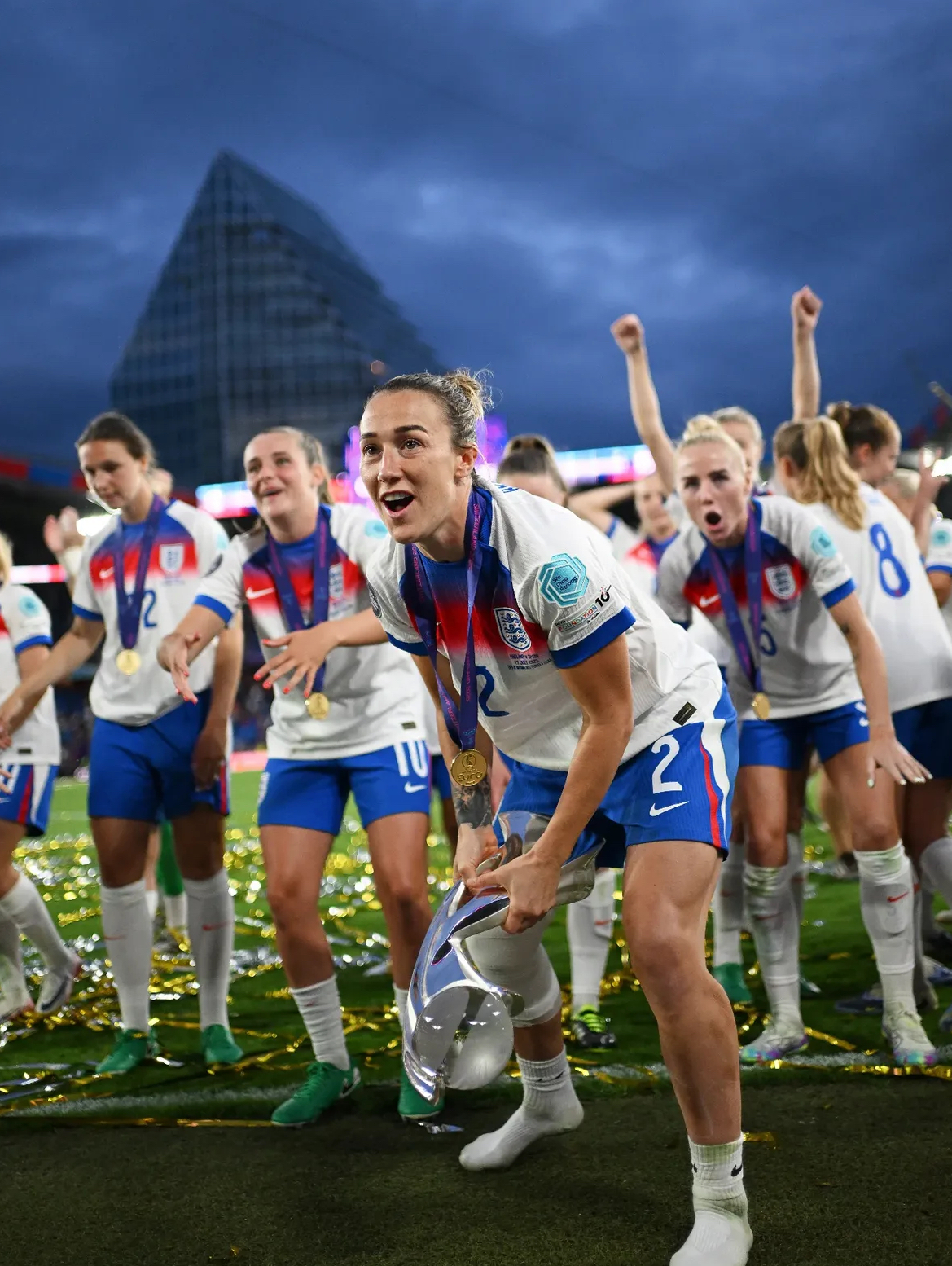
Arguably the biggest story of 2025 in women’s football was England retaining the European Championship in Switzerland. Their victory was far from smooth sailing. They struggled in their opening group game against France, losing 2-1, but rallied against the Netherlands and Wales to qualify from the group. Against Sweden in the quarter-finals, England found themselves 2-0 down at half time but with help from women’s football newest wunderkind Agyemang, drew level in the second half and won on penalties. Agyemang was again crucial, netting a late equaliser against Italy in the semi-finals to allow Kelly to finish the job in extra time and send England into the final.
In another tight affair, penalties were again required for England against Spain. Kelly scored the decisive penalty to send the Lionesses and the nation into ecstasy. The players were greeted by 65,000 fans at the trophy parade, the Lionesses now firmly established as the nation’s team.
Away from England, the Euros provided a number of memorable moments. The hosts Switzerland fought valiantly to reach the quarter-finals, as the nation fell in love with women’s football. Wales made their tournament debut and despite suffering three defeats from three, did their 4,000 travelling fans proud. It was fitting that their first major tournament goal was scored by Welsh legend Jess Fishlock. The tournament as a whole proved that women’s football was not a fad but something that was here to stay.
ARSENAL DEFY THE ODDS
If you were to ask Arsenal fans and the wider women’s footballing community in October 2024 about Arsenal’s chances of winning the Champions League, you would have likely been met with a chorus of laughter. Arsenal manager Jonas Eidevall had resigned due to a poor start to the season and Arsenal had hardly looked convincing in the games they did manage to win at that point. Then Renée Slegers took over. Eidveall’s assistant was initially given the manager’s role on an interim basis but was given the job permanently in January 2025. The former Dutch international had produced an exceptional turnaround, making her permanent appointment almost mandatory.
A real turning point for this run was Arsenal’s dramatic 3-2 victory against Bayern Munich in their final Champions League group game. After going 2-1 down, the Gunners turned the game on its head, with Mariona Caldentey completing the comeback with a late penalty. This resilience became a trend for the rest of their European campaign. Against Real Madrid in the quarter finals they found themselves 2-0 down after the first leg but won 3-0 at the Emirates in the second leg to progress to the semi-final.
Again in the semi-finals, Arsenal had it all to do in the second leg, trailing 2-1 to perennial European champions Lyon. Yet again, Slegers’ side found a way to win, hammering Lyon 4-1 in France to send them into the final against Barcelona in Lisbon.
Even the most ardent of Arsenal fans gave them much of a chance in the final against the all conquering side from Catalonia. Barcelona had won the Liga F at an absolute canter, finishing eight points clear of second place Real Madrid whilst also winning the Copa de la Reina and the Supercopa de España.
Yet, Arsenal upset all the odds. In an otherworldly performance, the team from North London found a way to go toe to toe with Barcelona. They nullified their abundance of attacking threat whilst also creating chances of their own. When Stina Blackstenius scored the winner in the 74th minute, Barcelona knew they were finished. Although all of Slegers’ side deserved plaudits, Leah Williamson produced a career defining performance of defensive astuteness. Her performance will rightly go down as one of the greatest in an Arsenal shirt.
It was fitting that Williamson, who was a mascot when Arsenal last won the Champions League in 2007, was the player who made the biggest difference.
BLUE DOMESTIC DOMINANCE
Whilst Arsenal conquered Europe, it was Chelsea who dominated on home soil. Newly appointed manager Sonia Bompastor had massive shoes to fill following the departure of club and women’s football legend Emma Hayes. Bompastor, who had won a plethora of trophies with Lyon, had little issue in bringing this habit to the blue side of London.
With relative ease, Chelsea completed an undefeated domestic season, winning the WSL, the Subway Cup and The FA Cup. This was the second time they had completed this feat, the first being the 20-21 season.
The squad was filled with world class players who had developed under Hayes mixed with Bompastor’s additions. Women’s football stalwart Millie Bright again proved why she is one the best defenders British women’s football has seen while new signing Sandy Baltimore fit perfectly into the Chelsea set up. Her move to left back proved to be a stroke of genius.
It was not just the defence that thrived. Aggie Beever-Jones produced her best goal scoring season to date, scoring 13 in all competitions. Lauren James struggled with injuries but when she was fit, she proved again why she is one of the best women’s football has to offer.
What was most remarkable however was Bompastor’s ability to get results whilst dealing with all manner of injuries to key players. As previously mentioned, James was in and out of the team but it wasn’t just James that was bitten by the injury bug. The talismanic Sam Kerr missed the entirety of the season with an ACL injury. The vast majority of sides would have felt a dramatic reduction in attacking output but Chelsea still managed to score the second most goals in the WSL with 54.
At the time of writing, it seems as if Manchester City will be putting an end to Chelsea’s dominance but if the 2024/25 season for Chelsea proves to be one final hurrah then it was some way to go out.
WOMEN’S FOOTBALL ENTERS THE MAINSTREAM
In 2025, women’s football thrived on the pitch. However, away from the grass, the sport continued to bring awareness to itself. With Scott appearing on ITV’s I’m A Celebrity Get Me Out Of Here and Carney winning BBC’s Strictly Come Dancing, women’s football icons continue to embed themselves in mainstream culture. While both Scott and Carney had massively successful playing careers, it’s been their post-playing endeavours that have given them the most attention. Scott has established herself as one of Britain’s premier television presenters while Carney is a regular pundit for various broadcasters such as Sky Sports and CBS. Their invitation on to two of Britain’s most popular television programmes is endemic of the growth of women’s football. This would have been unheard even five years ago.
On the pitch, Kelly and Hampton’s nominations for BBC’s prestigious Sports Personality of the Year award prove that women’s footballers are being placed on the same level as their sporting contemporaries. When Beth Mead won the award in 2022 followed by Mary Earps in 2023, they were seen rightly as massive achievements. Now these nominations are seen as commonplace.
ACL INJURIES PLAGUE THE SPORT
When looking at the negatives regarding women’s football in 2025, the continuing glut of ACL injuries should be near the top of the list. In the WSL season so far, players such as Reid, Naz, Marie Höbinger, Sophie Román Haug and Agyemang have suffered from the injury. Outside of England, Bayern Munich’s Lena Oberdorf suffered her second ACL injury after returning from the same injury earlier this year. According to the ACL Women’s Football Club, there has been nine ACL injuries in the WSL so far this season. In Japan’s WE League there as been 10 whilst there has been eight in the Frauen Bundesliga and Arkema Première Ligue.
Investment in research as to why the injury is so prevalent amongst female athletes is beginning to increase. The German Football Association, who have funded a “central injury and illness registry in women’s football for three years” found that female athletes are four times more likely to rupture their ACL’s compared with their male counterparts. Going into 2026, research into ACL injuries and their prevention should be one of the utmost priorities in women’s football.
A RISE IN ABUSE
If the prevention of ACL injuries is one of the utmost priorities in women’s football in 2026, then tackling the rise in abuse of players has to be the other. As women’s football and women’s footballers gain more exposure, so does their exposure to the darkest recesses of the internet and beyond.
Throughout 2025, many of the sport’s most high profile names have experienced all manner of abuse. Most troubling of all is that much of this abuse has been racist. At the 2025 Euros, England and Gotham defender Jess Carter suffered horrific racial abuse on social media. Man City forward Bunny Shaw was also a recipient of similar abuse on platforms such as X and Instagram. The rise in abuse was such a problem that Sport England chair Chris Boardman wrote a letter to Ofcom, the regulatory authority of communications in Britain, outlining his concerns.
What is most concerning is that for a sport that prides itself on alleged inclusivity is in fact a myth. Everyone from those at the top of the sport down to the humble fan has the duty to call out and tackle all abuse they encounter. Until that is done, women’s football cannot truly call itself a space for all.