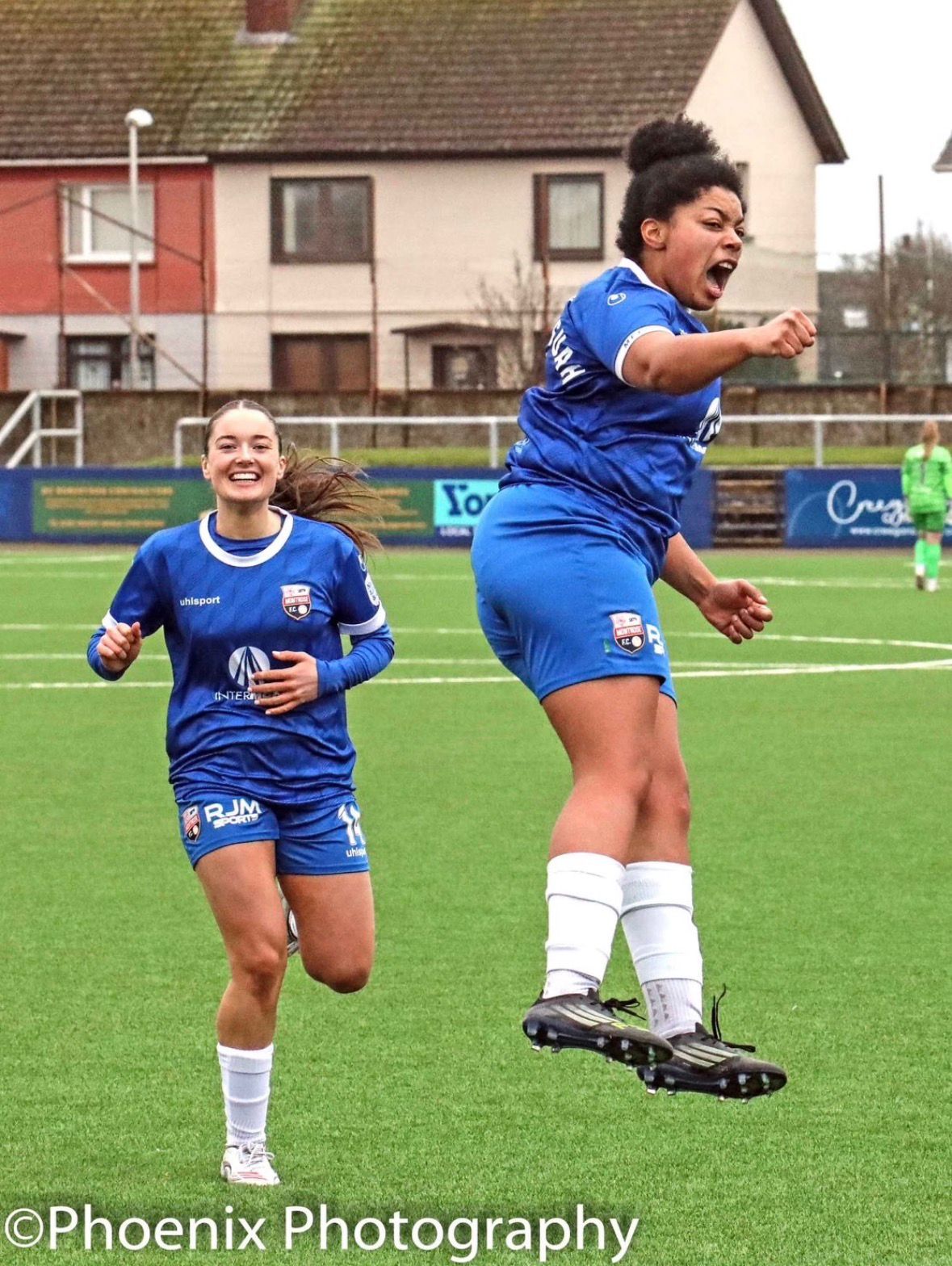
If you’ve watched the Scottish Women’s Premier League (SWPL) this year, then you’ll know who Kaela McDonald Nguah is. If not, then strap yourselves in because you’re about to learn, and you might get persuaded to make the small trip to Montrose in Northeast Scotland to watch her.
Kaela McDonald Nguah is the unique type of character you get in Scotland, where the top division is still split halfway between professional and part-time. A game-changing striker on Wednesday nights and Sundays, she is an attitude-shifting anti-racism educator on the day job for Show Racism the Red Card Scotland.
Like many, Kaela’s story started as a child, watching football on TV. After enough begging, her mum finally broke and allowed the young Celtic fan to try it, and she was so convinced she even dropped dancing to pursue her new love. Reflecting on those early days and where she saw her future, McDonald Nguah said:
“If you’d asked me at that point if it was going to be something I’d still be doing 20 years later, then I probably would have laughed.”
Things progressed well for Kaela, and she soon found herself in her ideal academy.
“It felt like a bit of a dream, because I grew up a massive Celtic fan. I used to love playing in the kit every week, especially every new season, seeing all the new training kits, getting access to it. So I was just like a big kid enjoying a dream at that point. I got to meet lots of different people as well, it was a really positive experience getting to meet so many different people.”
Having come through the academy, as many players do, she made the decision to leave Celtic in search of regular football and the next step in her development. However, Montrose’s number 11 was keen to emphasise that there was “no frustration at all” with the club for how things panned out.
“Leaving Celtic I was a little bit sad, but at that time I knew I was a young player. I knew my opportunities would be limited staying there and I felt that I deserved to go and try and get some more minutes elsewhere. It’s never a time I look back on negatively at all and I think it’s only made me the player that I am today. It might have panned out a lot different. I could have stayed there for a couple of seasons, got frustrated, maybe even chucked football altogether. So there’s no resentment on my end.”
McDonald Nguah played at a few different clubs after Celtic, most notably Motherwell, before she eventually moved to Gartcairn in the second tier. Questions arise as to how a talent like hers found its way to that league, and Kaela provided a candid reminder that players are, ultimately, just everyday humans:
“I think I dropped down a division again just trying to find the enjoyment. I was at Gartcairn and some off the field issues brought me to a point where football was the one thing I felt I could control and I wasn’t happy there.”
She managed to secure a loan to Dundee United in January 2025, where she found an ideal environment.
“There was an element of it — there’d be no pressure when I joined, because even without it being mathematically confirmed, they were likely to be relegated.”
“I wanted to see if I could still do it in this league and if I enjoyed it.”
Luckily the 25-year-old found two positive answers in her limited time with Dundee United, before their relegation was confirmed. This gave her the impetus to push to get back into the SWPL next season. Having said no to Montrose before on the basis of a long commute, head coach Craig Feroz’s words were enough this time, and McDonald Nguah would once again be a name shouted and feared in Scotland’s top league.
With the SWPL reduced to 10 teams that summer, Montrose had survived by one place the final week of the season in 2024/25. This meant expectations were relatively low. Fighting against big names like Aberdeen, Partick Thistle and Motherwell to avoid ninth place and a relegation playoff, bets were pretty much split between those three and away from ‘the Mo’. Sitting six points away from that playoff spot with five games to go, they have arguably been the best side in Scotland this year.
However, the club’s very own standout signings insisted she knew something we didn’t about the quality this squad possesses.
“I knew of a couple of other players that were coming in and I know the group that were there. They’ve got some really experienced players like Cassie (Cowper) who’s been in the Scotland youth set up, Jade (Mclaren) as well. My thought was why can’t we go and try and challenge for top six? Not necessarily get it, but why not challenge for it?”
Whilst they did miss out on an elusive place in that top six split, which would’ve guaranteed them survival, they can still be beyond proud of their efforts this year, and certainly McDonald Nguah’s predictions were more accurate than most others.
When it comes to her attributes, Kaela is reluctant to blow her own trumpet, yet professional enough to respond.
“I can hold the ball up which is obviously a big strength for teams that aren’t full time. There’s times when you play these top teams facing waves of attacks, so you need that outlet.”
The words strong, vision and technical ability all crop up too, as comes the reveal that she was a midfielder throughout her career, up until a couple of seasons ago.
“I’ve not been easiest to work with as I do have those midfield tendencies in me. I get told before every match I’m not allowed to go outside the width of the box because I like to float. I’m allowed to move about, but at the same time my strength is a focal point and I need to be up there scoring goals.”
The ex-midfielder has clearly been listening to Feroz’s advice, scoring just under half of Montrose’s total goals. Unsurprisingly, this is the highest total in the league and with an SWPL player of the month for December in her pocket, it’s been an outstanding season for McDonald Nguah.
Despite a proclamation that “I’m not a player that needs to be told ‘you’re doing amazing,’” she cordially accepted that her goalscoring record made her “really proud”.
“I’ve always liked scoring goals, but I’ve maybe lacked that hunger to be a goal scorer. That is something that I’ve had instilled in me this season. I know that I’m producing in a way that’s helping the team so it’s a nice feeling.“
From England, where two fully professional tiers exist, the idea of professionals facing amateurs week in, week out seems unthinkable — but in Scotland, it’s standard. When questioned on how she feels about the disparity, McDonald Nguah said she’s
“Always seen it as a motivator. I was thinking about the way that they’re being paid to beat us. So any small win you can get on the day, you love it. For example, when Celtic beat us 1-0 in January, I know that would have hurt for them. They would have turned up thinking of scoring 5, 6 or more goals. With the increase in terms of fan media, I see on my tik tok that they’ve got a good fan base, who before the game were expecting five or six.“
Ultimately, the reality of the gap is that while:
“no one wants to get beat, you have to accept that losing is just going to be part and parcel playing these full-time teams. On the flip side, however, if they don’t beat you by a certain amount it’s like the world’s ending. Whereas if we limit it to 1-0 or 2-0 everyone thinks that’s brilliant. There’s pros and cons on both sides.”
As touched on earlier, Kaela balances her football with a role as an educator. In terms of balancing that with playing football, she felt:
“really lucky in terms of the job because most of my work is with schools. For my two training nights I can finish a little bit earlier, the latest that I would maybe finish after school would be three or four o’ clock and that means I can head up to training.”
A massive part of making it work is having an employer who understands what it’s like to be a footballer and what that might mean for their availability. Naturally, being founded by a player, Show Racism the Red card (SRTRC) are:
“really accommodating. When we have rearranged games, I can get my leave sorted fairly quickly and they move things around for me. When I compare that to some of the players in our team who work night shifts – coming to the game and then going home and doing the night shift again. I can’t have any complaints in terms of that work life balance.”
In terms of what the actual work entails, McDonald Nguah clarified that:
“most of my work will be in schools, delivering workshop sessions on anti-racism. We teach them what racism actually is, different forms of racism and look at racial literacy as well. We talk about stereotyping and biases and the impact they can have, and how we can be influenced to feel negative thoughts about certain groups of people.”
“Most of our workshop is based on giving them time to talk. They’ll discuss these topics, and that’s where we see the most benefit. Because if you’re a young person and you’ve maybe said or done something previously, and then your whole class is talking about how that’s wrong, then that’s the kind of difference that we see.”
While schools and football teams are often where you’ll find Kaela, SRTRC will run sessions with a range of groups, including Rugby teams, Basketball Scotland, and in particular she mentioned how they’d done a number of events within Falkirk after some anti-immigration protests taking place there since the summer.
While it cannot be an easy job at all times, McDonald Nguah actually found that what she liked about the job was:
“the different people that I’m speaking to. It’s not always people that agree racism is wrong. You want to go and speak to those people that maybe are on the fence or maybe slightly over in terms of some of the thoughts and ideas they might have. That’s the more rewarding part of the job.”
Given that Kaela is one of very few players of colour in Scottish women’s football, her experiences of racism were unfortunately all too familiar:
“When I played in boys football, I had the N word used towards me. I’ve been spat on before. When I have been in women’s football I’ve felt more of those biases, microaggressions and stereotypes.”
While talking about racism is something that keeps the electricity running for McDonald Nguah these days, it is not something that she always has done or felt comfortable with:
“It was difficult, I can speak about this now, and it’s my job, but I never spoke about any of my experiences other than speaking about it with my mom until about 2020. I was asked to do a podcast talking about Black Lives Matter. I had a lot of positive feedback off the back of that, which was really nice, but also a lot of people were shocked, which then shocked me and my mom. This happens on a daily basis. These are things that happen all the time.”
Kaela said she had found hope through another experience of racism she had. As she recalls:
“I had one experience where I’ve had a comment made when I was playing for Scotland under 17s. It was by a player from the Croatian team. It obviously wasn’t a nice experience, but it was the rest of the team that brought that person up to my room to apologise. That was accountability from people that were 15, 16 at the time. It’s always something I look back at with hope because there were kids from a whole different country, different culture, who recognised it was wrong and challenged somebody in their own team about it.“
Whilst women’s football is so inclusive and accessible in so many ways and this should be celebrated; there is certainly an underrepresentation of people of colour compared to the men’s game and society as a whole. It’s an issue often explored as if certain teams, like the English national team or WSL sides, simply don’t reflect their communities, while the deeper, underlying reasons aren’t always considered.
McDonald Nguah was of the view that:
“It’s something you need to look at more deeply. I know for example the SFA are doing so much groundwork to try and make grassroots more diverse and start it at an early age. There’s obviously something in the pathway blocking players of colour coming through. If your football team doesn’t represent the spaces that you’re in everywhere else, that’s where you start to have a bit of a problem.”
“I’m even at the point now where I’m actively recognising if I see a young female player of colour playing in Scotland. I’m like ‘brilliant that’s fantastic’ because for as long as I’ve played there’s only ever been myself playing and one other in Scotland. I remember being younger and looking up to them.“
“It’s also not just skin colours. We need to think about players coming through that have adhd, anxiety and depression as well”, she was quick to add.
While she does envisage the general diversity of the game to naturally increase, as:
“Scotland’s becoming more diverse, so if we’re not seeing that come through in football or sports, then we need to start taking that up as well, she’s also wary that
“the problems such as how people may react to a more diverse set of players will increase as well.“
It is not a simple story though. Through her work with SRTRC Scotland, Kaela has seen first-hand that:
“We’ve not done as much as we’d like with women’s teams, which is a bit disappointing. It’s something that that has been offered to them, but it seems that while the men’s team and academies take up the opportunities, it’s not always the same with the women’s sides.”
With academies for girls increasingly mirroring how the boys’ work, McDonald Nguah was still happy with the situation, hoping that they would ensure that girls also can access educational opportunities like anti-racism or to help with getting jobs in the future.
A fully professional top tier “has to be something that’s aimed for,” according to McDonald Nguah. Referring to her current team, she stated:
“I wouldn’t even call us part time, it really is a hobby compared to everyone else.”
She highlights that while progress has happened throughout the world in recent years, the reality of football still looks like this for some countries top players.
Once more, as someone within the game, Kaela’s insight that “year upon year the kind of factors or tick boxes you have to hit as a club are improving, which will only help,” is a great thing to see, as progress doesn’t always feel or look like it’s being made in the Scottish game.
However, she also thought that:
“it just needs to be advertised a lot better. I went down to watch a Lionesses game and just the whole way they marketed it was fantastic.”
With Scotland’s two biggest men’s clubs, Celtic and Rangers, turning professional in recent years, that brings a huge fan base, while Hearts and Hibs also contribute sizeable followings from their men’s crowds. Kaela was grateful to be:
“starting to see those fan groups developing up in Scotland, but they need to take advantage of that as well, which I don’t think they do enough.”
With four professional leagues in the men’s game, which itself is mind blowing for the size of Scotland, the feeling that at least one women’s league should be professional, and the growth which the league would see by having such a competitive table, surely means that it’s only a matter of time.
Whether or not a pro contract is something that comes for McDonald Nguah in her career, she’s at peace:
“I’m at a point now where, realistically, if it was going to happen it might’ve already happened, but I’m not going to let that stop me being the best I can be. I’m enjoying my football. If that option did ever come up I’d take it with both hands. I get to play football and I have a job that I enjoy too, I think looking at it my life it’s something that people would fight to have.”