The life of a professional footballer comes with many forms of sacrifice and early struggle that go beyond the glamour of being a full-time earner in the game.
For Natalie Johnson, looking back on a decorated career in women’s football brought plenty of smiles, but above all, a real sense of gratitude for everything she has experienced along the way.
Speaking exclusively to Beyond The Pitch, Natalie, otherwise known as Nat, journeyed how her love of football came from an early age. It follows a similar path to many aspiring female footballers who ultimately had to settle for playing with the opposite gender as a child. It started with playing alongside her elder brother, where her father was the coach of a local team. “I just begged them to let me go with them for training one day”, Nat said. “I just played with the boys. I was fairly good at football, so I continued to beg them to take me with them, and they eventually agreed.”
Making Big Strides and Big Tackles
That level of participation came to a head at the age of 12, where it was no longer allowed to play with the ‘boys’. Fortunately for Johnson came the opportunity to get picked up by Leicester City, which is where the storied adventure really began. Yet those early experiences moulded a love of defending:
“I loved a big tackle. I loved reading the game, and that was with lads that were twice my size. I enjoy the tackling side of the game, and the read in the game rather than going forward. It was definitely in my blood from day one.”
In 2012, Johnson took the decision to move from The Foxes and head to America to pursue a college degree in science. Describing herself as a “super nerd”, she went on to study biology.
“It was amazing going to the USA,” Johnson said, describing the independence and life lessons that moving overseas gave her at just 18 years old.
“It was important for me as well to still get my education, and play football at a high level. So that’s what helped me decide that’s what I wanted to do because I could get the best of both worlds out there.”
Her two worlds collided four years later when she returned to England to play for Leicester City. However, the Foxes were not yet a fully professional club offering full-time contracts. Consequently, Johnson had to divide her time between a pathology lab and the training ground.
“I was balancing science and football,” she said. It marked the start of a relentless period spent juggling her passions with earning a living, both with Leicester and later while living in Leicestershire and playing for Sheffield United in South Yorkshire – a 90 minute car journey between the two grounds.
“I was still working in the lab and playing semi-pro in the Championship for quite a few years. It was a lot of time management, but just being pretty exhausted all the time. So I would work 08:00 till 16:00, get in the car, drive to Sheffield… after work – train, come back about midnight, and then do it all again.
It was a really challenging time in my career because I was doing a lot, and the contracts weren’t sufficient for me not to work. So I was playing a high level of football, but working all day.”
Reflecting on that graft, Johnson sees invaluable lessons she couldn’t have learned any other way:
“I think again [about] that stage of my career [and it] really taught me a lot about what I’m capable of and how much I wanted to play football.”
Taking the leap into full-time football was a daunting prospect, but a strong support network helped her take the plunge.
“I think they [my family and friends] all knew that 4-year-old Nat playing football with the boys would have wanted to be a professional footballer. So they all thought it’s worth the risk, no matter what happens.”
From Club Survival to Title Joy
Describing her time in Sheffield, Johnson says that she “learnt a lot” and “really loved playing” for The Blades. After her stint with Sheffield United, Johnson moved to Coventry United. It was a decision driven by both practicality and personal growth.
“So I signed for Cov, which was a bit closer to home,” she explains.
“It meant I could stay and live and work in Leicester. And that was my first full time contract that I signed as well. So that was really exciting.”
However, her initial months were thrown into chaos by an unexpected financial crisis off the pitch, as the club went into voluntary liquidation in 2021.
“It was a difficult time. It was around Christmas. I spent the whole of the Christmas period thinking ‘I need to find a new club’. It was really difficult,” she recalls.
The club was hit with a 10-point FA deduction, taking them from six points to -4 and leaving them rooted to the bottom of the table. After losing their first four matches post-deduction, Coventry mounted a dramatic eight-game unbeaten run of four wins and four draws. A thrilling 1-0 victory over Watford on the final day of the 2021/22 season, courtesy of a 97th-minute winner from 35 yards by Mollie Green, dramatically secured survival.
“We got up to 10 points, and then we managed this great escape where we didn’t lose for eight games, and we managed to stay up. So that was also a crazy time, but one that taught me a lot, and probably some of my fondest memories, doing that.”
A move to Lewes FC followed, where an FA Cup quarter-final loss against Manchester United stood out as a clear highlight. Johnson came close to scoring herself, before her effort was blocked by Maria Thorisdottir.
By 2025/26, Johnson reached another high with Nottingham Forest in the third tier, securing an unbeaten league season while winning both the FA WNL Northern Premier Division and the WNL Cup. Without a second thought, the defender said:
“You can’t really match that, can you? For me personally, it was one of the best seasons of my career.”
Leadership played a central role in that achievement.
“I very much lead by example, and we had a lot of new players in the building [during the 2024/25 season]. So for me as a leader, it was about really what I was doing on the pitch, but more what I was doing every day in the background to get the team to connect.”
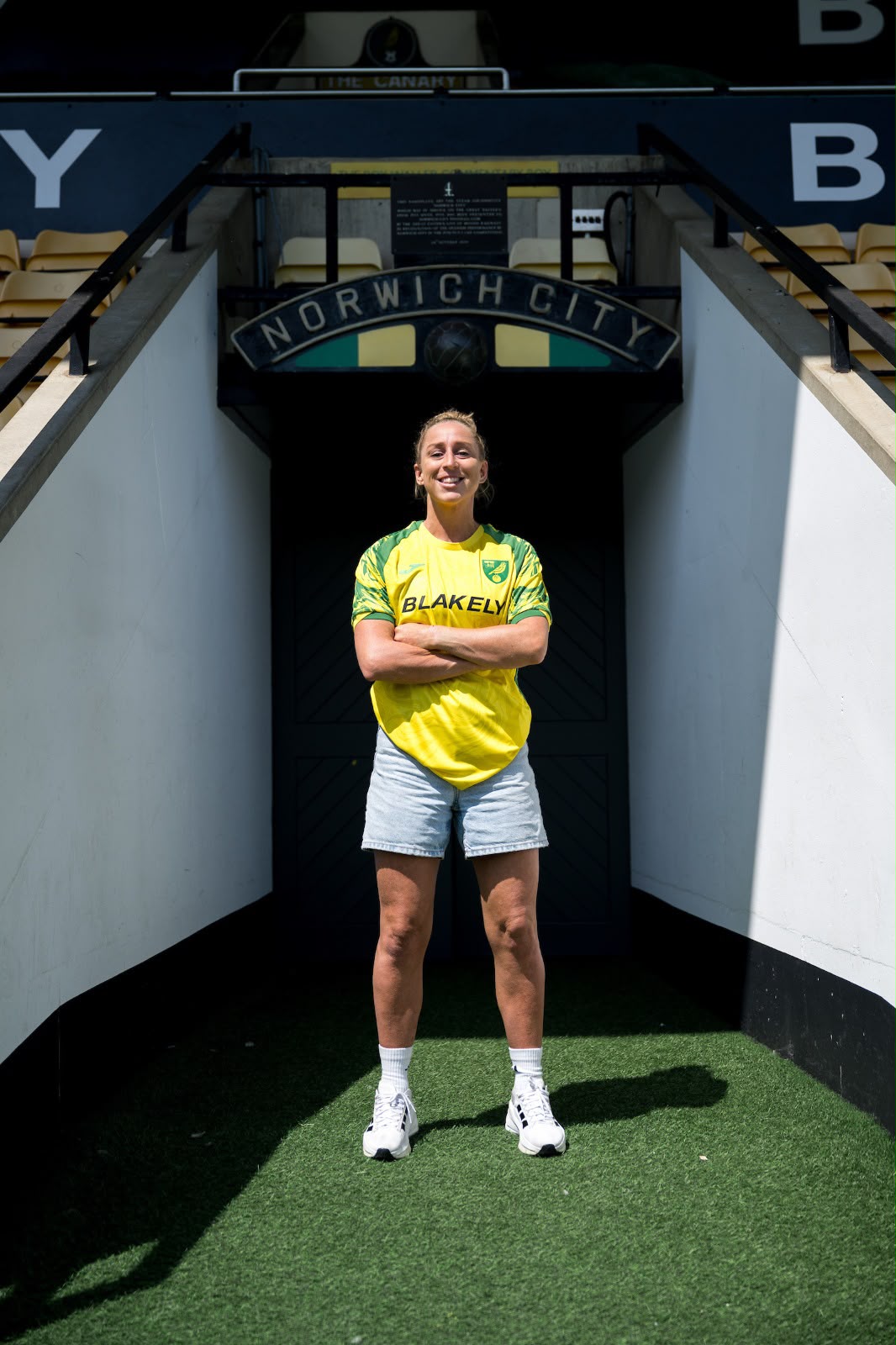
That successful chapter at Forest opened the door for her next step at Norwich City. The club’s clear direction and thorough recruitment process immediately stood out.
“I was keeping tabs on Norwich a little bit last year because I’ve got some friends that play for Norwich,” the 32-year-old explains.
“As soon as I had a conversation with Flo [Allen], who’s the GM, and Perry [Northeast], who is the new manager, immediately I thought, wow, like this is kind of an exciting place to be. The messages from Flo on the ambition of the club and the trajectory and the professionalism really really appealed to me.”
The manager’s attention to detail proved equally decisive.
“It’s important for me as a player to know that the manager’s done their homework,” she says.
“Perry had done his homework on me. He had clips of me from years ago that I didn’t even know existed. So I was really impressed with his sort of in-depth analysis of my game and how that is going to compliment the style that he wants to play.”
Pride of Wearing International Colours
Beyond her club career, representing Northern Ireland on the international stage provided another defining benchmark.
“Whenever you’re playing for your country… it’s just another step up,” Johnson reflects.
“It’s just the pinnacle of your career. This is what I worked my whole life for, so I give every single ounce that I’ve got whenever I’m playing for my country.”
Now, she brings that international standard into the Canaries’ dressing room as a steadying Influence.
“At Norwich, we’ve got quite a young team, which is why it’s so exciting to be here and have someone hopefully like myself who can impact them with some of the things I’ve learned both internationally and at home and in America.”
In many ways, the move brings her career full circle.
“I have a house and a fiancée and a dog in Leicester still, but I am doing my best to spend as much time there as I can whilst living in Norwich for football.”
Looking back across a career that spans the full evolution of the modern women’s game, Johnson reflects on the legacy she hopes to leave behind:
“I’d hope that my legacy would be that I have lived through the game at all its different stages, so from amateur to part time to semi-pro to pro, and along that journey, I hope that I’ve made the game a better place and impacted the players and the clubs around me as well.”
Now as a veteran, her focus remains firmly on elevating those around her and building a foundation for the next generation.
“My ambition is a bit like with Forest to get Norwich into a place where girls in Norwich can play professional football at a higher level.”