While elite women’s football continues to break records and attract global attention, countless grassroots stories remain hidden in plain sight. Some of the most powerful stories in football often go untold and never reach the headlines. They unfold on local pitches, far from television cameras, where grassroots teams build legacies that often go unnoticed. South West Saints is one of these very stories, shaped by sacrifice, persistence, and shared belief. This inspiring story is one that has rarely been acknowledged but captures the very essence of why the game matters.
South West Saints are a grassroots team that, despite their short history, have been writing a chapter of dignity and determination to etch their name in football heritage. Calling the pitches at Clapham Common in South London their home, the Saints began their journey in 2024 after the decision was made to break away from a men’s team, with the driving factor being told that “Saturdays are for the men. After hearing those words, it confirmed for them “independence wasn’t optional. It was the only route.”
Despite this disheartening statement thrown their way, this didn’t stop the team but instead acted as an accelerant to achieve success as a separate entity. With “a collective refusal to accept being an afterthought”, there has certainly been a notable increase in the number of independent women’s football teams emerging to create their own name with South West Saints adopting a similar ideology.
They recognised that starting an independent side detached from a men’s club came with risks, with the biggest one being starting afresh from absolutely nothing- no inherited infrastructure, no brand recognition, no safety net. But this decision also allowed complete freedom, meaning it allowed “South West Saints to become fully intentional.” The club has been built deliberately brick by brick in every aspect from culture and decision making to visual identity, tone, and standards considering there was no legacy or rules to be constrained by.
From the very beginning, the aim was to build a brand that was a true representation of their values, on top of a team. To stand out from the rest visually in the league, club founder Chumani Ward spent time researching photographers where she discovered Marcel who has been an integral part in building the team’s desired brand. And now “his photography is the heartbeat of [their] socials- he captures the art in the sport and his authentic style is now synonymous with South West Saints.”
Once the wheels were set in motion, the rest is history.
When a new team arrived in the league, they were viewed as the underdog and not many expected them to be flying high from the get go. But before their inaugural campaign had even begun, the South London based side had already proved they had plenty of talent within the squad by winning not one, but two amateur FA tournaments during the summer of 2024. When it was time for the 24/25 season to begin, the momentum only continued and the Saints had quite the season.
The team proved their recipe of culture, passion and creativity to win games was certainly a successful one both on and off the pitch through an incredible debut season of football. On the pitch, one success included the league campaign. It’s safe to say the Saints have already found their feet and have become a force in the league, finishing second place during their first campaign. But not only this, the team also managed to claim some silverware as they competed in the London Women’s Saturday Football League Division One Cup, again for the first time.
Despite facing a number of established multi-team clubs, South West Saints came out on top proving exactly why they shouldn’t be underestimated. Including a win over biggest rivals Athenlay and defeating the previous titleholders, Stonewall FC, who were fresh out of unbeaten season with a dominant 5-0 win, the underdogs in the Saints were crowned champions at the end of the competition with a 1-0 win against Peckham Town.
But off the pitch, they’ve built a group where every player is valued and every achievement big or small is celebrated. The squad have a range of backgrounds from academy roots, to some who were new to the game, to some regaining their love for the sport after time away from the pitch, but this certainly didn’t stop them from building the strong sense of community they uphold and the beautiful culture within the club.
And two crucial things involved in this journey for South West Saints has been the local community but also storytelling through kit design.
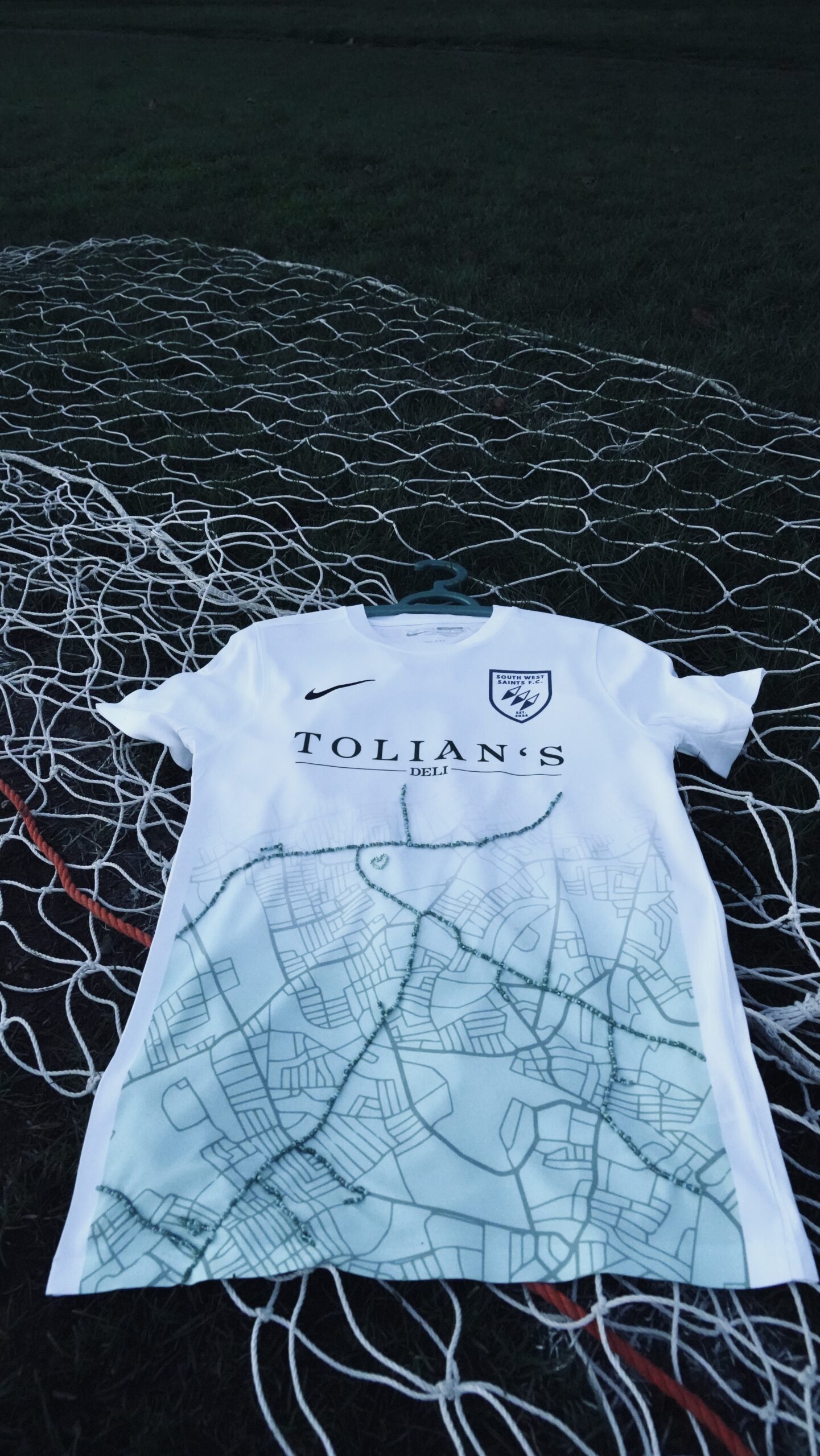
Local businesses such as Tolian’s Deli have backed the Saints since the very start of their journey, sponsoring the team as well as providing crucial investment. But to the team, “they’re not just a sponsor” but rather “a part of the South West Saints DNA”. Their backing has allowed the team to fund their kits, a place to train and reduce costs for the players to participate in the game they love. The best part of the sponsorship is giving the team the opportunity to grow on their own terms, and having a genuine desire for South West Saints to succeed.
For the launch of the SWS kits, the club teamed up with Track’s Pizza, another business in the local area. With Track’s hosting local pizza pop up events, they know just how to bring a community together, perfectly reflecting the values of the Saints. In fact, Tolian’s supply their ingredients making it the “perfect local ecosystem” backing the club.
The launch with Track’s Pizza was for the shirt released last year but with a creative and unique new addition. The new version of the kit features a map based design with South West London routes, traced in embroidery beads. The kit will not be played it but instead breathes new life into a beloved design.
An element that is slightly different in their league is that every match, both home and away, is played at Clapham Common and because of this “the route to the common becomes a ritual rather than just a commute.” With the team travelling from different parts of the city, tracing individual routes highlights that despite the fact “[they] arrive from different directions, [they’re] moving towards the same point each week.” South London is just where they play, it shapes and operates who the Saints are.
The other kit that was launched is a retro-inspired shirt, with sketches of key moments and celebrations from their first adventures as a club. This special edition shirt isn’t just a kit. It’s a hand-drawn document of everything the Saints have achieved, drawn from real moments captured by Marcel, then brought to life in illustrations by player, Holly Blount. Each individual sketch makes a memory permanent in SWS history. She outlines the design of this kit as “From semi-final celebrations to underdog heroics, the shirt speaks to friendship forged through competition, creativity as a form of showing up, the determination it takes to build from nothing, and our shared love for the women’s game.”
The illustrations range from Club Founder, Chumani Ward, lifting their first trophy as a newly formed team, a now regular celebration of a group hug, the “hands in” ritual to bring energy to every game to moments like Saints player Emma celebrating after reaching the cup semi finals beating the team they narrowly came second in the league to in the previous season which also happened to be the first game Tolian’s came to watch, the team storming across the pitch to celebrate their 5-1 semi-final win against a larger club, Camden & Islington United and Vice Captain & Welfare Secretary Lauren cheering into the camera for the first game of this season, where the team have since not dropped a single point.
The aim of this kit is to showcase the achievements in the early days of the club as this is where they “have found their place. It also allows the “players to feel like the main characters they are” but also acts as a “wearable trophy cabinet” and an opportunity to display these achievements. To the team, it’s important to celebrate and mark these moments as they come, and not wait for something ‘bigger’ to come along. For them to have so much success so early on was incredible, so they knew they had to harness this energy while it was fresh.
Whilst the shirts feel closer to art pieces than traditional kits, it has proved a perfect way for South West Saints to express their culture and tell their story through their own unique designs.
In the next few years of their journey, on the pitch the Saints aim to continue setting standards and shaping the league they are currently in rather than progressing to higher levels at the expense of their culture. Whilst moving into more competitive structures was an available option, it would mean letting go of part of what makes the club such a special one. Off the pitch, the target is continuity. This included building bonds that go beyond the sport and a community that welcomes new players with open arms.
Visibility is key to the growth of the women’s game and shaping its future but yet “clubs outside the top tier are often invisible regardless of the quality of their culture, football, or identity.” Grassroots football is full of stories that are easy to miss and hard to forget- if only they are given the space to be heard. Football’s most meaningful narratives often exist beneath the surface, overshadowed by larger stages and louder voices.
The club have created a space where they are the stars of their own show paving the way for other teams to recognise going alone can shape a team to be better than ever before. At the grassroots level, women’s teams just like South West Saints carry stories shaped by struggle and solidarity that rarely receive attention, but deserve it all the same.
Long after results are forgotten, what remains is what this team has built: confidence, community, and a sense of belonging that extends beyond the pitch. These are the quiet legacies of grassroots football- rarely documented, deeply felt, and passed on to those who come next. In the end, this is not just a story about football. It is about persistence in the absence of certainty, about community formed through shared effort, and about women who kept playing when the game offered them very little in return. These are the stories that sustain the sport, whether or not they are ever told, though they certainly deserve to be.