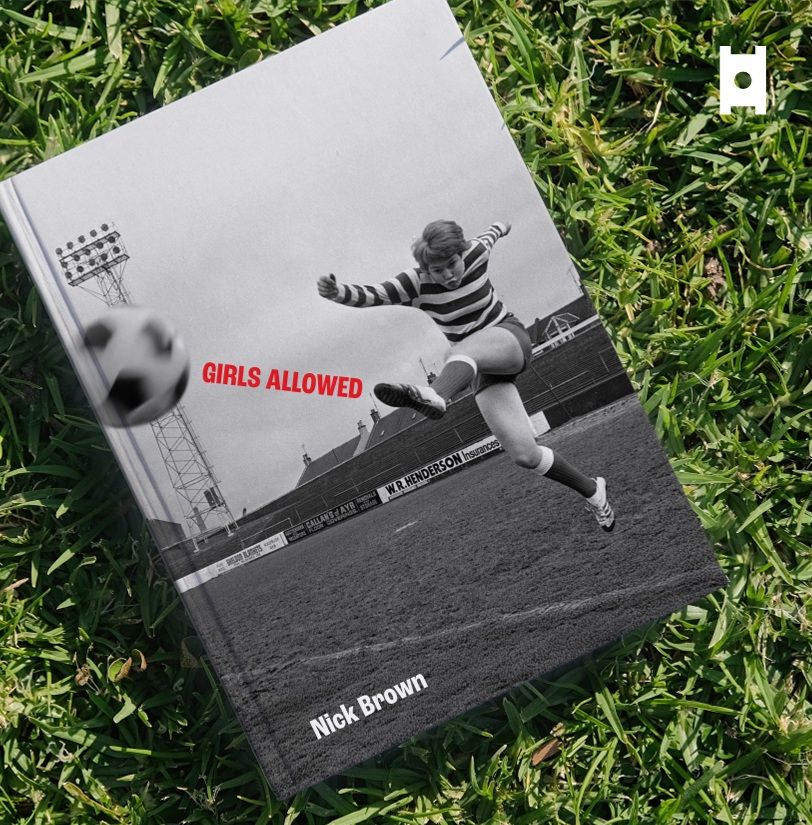
Author Nick Brown has published his book ‘Girls Allowed’. It details the history of women’s football in Scotland and England. The good, bad and baffling is all laid out in this book, and we spoke to Brown to understand why he wrote it and why he thinks you should go out and buy it.
Starting off, how did you get into writing, and football writing specifically?
I did a journalism course at college. After I left school, I worked for local newspapers in Barnet as a sports reporter. I’ve always been into football as most lads are when they’re young and I always wanted to do writing of some kind or other.
Then the problem with doing writing and journalism for a living – firstly is the mad hours and secondly is if you’re just sort of writing articles, you need something to be ongoing, otherwise you make no money whatsoever. So, when I got married and we had children, that had to go on the back burner.
But that was 32 years ago now. It was actually in lockdown when I started writing again. I thought, well, forget it, why don’t I start writing again? So, I did a couple of articles just to see if I could, sent them off to various websites and they published them. Then I thought ‘well, let’s see if I can actually write a book’- just to see if I can. So, I wrote one up and sort of self-published it, and so it turns out I could.
What’s your experience with women’s football and why did you want to focus on its history in Scotland?
Well, it came out of my own foolishness really, having seen the women’s game take off down here when England won the Euros the first time. Everyone was suddenly mad for it and the game came on leaps and bounds.
I foolishly thought that would be the same everywhere. In Europe and South America they’re all for it. I was doing a little bit of research and found out that in Scotland at the time there were only three professional clubs. I thought: ‘that can’t be right’, but it was right. then you start thinking why is that the case? What is going on up there? it just snowballed from that.
What conclusions about the women’s game in Scotland did you find and why did this motivate you to write the book?
Firstly, my own curiosity. I wanted to find out why because any little snippet of anything I get, my first default is ‘research land’. So, I just started looking into it. I wrote to all of the clubs that I could find addresses for in Scotland, but not Celtic, Rangers and Glasgow City (the professional clubs).
The first ones to write back to me were Hamilton. I got back in contact with them and just spoke to the manager for a while to see what it was like and how it was just trying to survive because everything’s amateur; the players are amateur, the staff are amateur, they go to work, have proper jobs, can train if they can get there, and then are playing just because they like it.
Doing more research, you find out that it was banned and it was just, why? What’s going on? I just started from that and then lo and behold, a book came of it.
What were your main challenges in trying to find sources and information?
It’s difficult, even old newspaper articles – if they were included, were old and not a huge amount of them have been digitized. What’s happened in the past has mostly been buried. So, it was just through speaking with people, getting connections and names to look out for.
If we’re going right back: Nettie Honeyball who founded the British Ladies Football Club. Someone who I’d never heard of before. When I looked her up and found out she worked with whoever, then you start building the picture.
In terms of modern day football in Scotland, especially women’s football, there’s next to nothing. A lot of my research was talking to people who’d had contact with the game. Looking at what challenges they faced and how they see it going.
There isn’t a huge amount of material available, and whatever you find, you just have to piece it together and you’ll find a lot of it contradicts anyway. It’s about trying to work out which bit is true.
Then the struggles that the amateur teams have against the professional teams, which is just a crazily unfair playing field. Hamilton, for example, said they were looking for a sponsorship deal for about £3,000 which would have kept them going for one season with all of their expenses. Whereas Rangers are running on £1M. Then I start thinking ‘well that’s not fair’, and it goes on from that.
The way it works at the moment in Scotland is that there’s five fully professionally clubs and five who are not. What do you make of this and how would you resolve it?
If I knew that, I would be running the league. It’s slowly moving in the right direction because obviously Hearts and Hibs are now professional and Aberdeen have started down that path as well. Naturally I think sponsors want to be associated with the big teams, so they get the TV exposure.
I don’t know whether it’s actually lack of interest or just lack of knowledge. You see the highlights on a Monday evening, and the stadiums they play in are pretty empty. It needs to be out there in the public consciousness. I think it also comes down to the clubs advertising the women’s sides of the club more, which is slowly happening.
I don’t know how long it’s going to take until everyone is on the same level, but it will take people being prepared to risk losing money and fully committing.
How would you kind of describe your book to people?
First of all – go and buy it, see for yourself. ‘Potted History of the Woman’s Game’ is how I’d describe it. We had to keep jumping between England and Scotland to understand why things happened at certain times. It seems that things would happen down in England, then in Scotland.
I’m certainly not the expert on it by any means, because there are no doubt other people with other stories that I have no idea about.
Comparing the struggles that the lesser teams face, not just to keep up on the pitch, but to keep existing. It was just really quite eye opening to see inside Hamilton, how they operate and run against someone who is obviously professional and comes in and trains every day.
The captain, Megan Quinn, made a little diary for me which was nice. It’s sort of an anti-football diary. Compared to a professional – who’s life would be full of training and sponsorship meetings, her diary was basically ‘I went to work, it all kicked off so I was late to training’, or ‘I missed training, therefore I can’t play Sunday.’ The contrast is astounding.
A potted history of the game and its struggles – that’s what I’d describe it as.
Where do you see Scottish women’s football going in the future?
Hopefully they’re on the right path. I don’t know what’s going on in the background at the SFA and SWPL, but with more and more clubs becoming at least semi-professional that has to be a good thing. The contrast with that is we’re almost in December and the champions of the second division haven’t got their first point in the first division yet.it is going to take time.
I would love to see it all go professional because then it could be more competitive and therefore the teams improve and just naturally get better and the league gets stronger.
It is all down to money; I think clubs need big sponsors to come in, for example local companies, to just take over the club and bankroll them for a while so that they can get on a roll. It will take time, I just hope that clubs don’t go to the wall before the professionalism actually kicks in.
You’ve worked closely with Hamilton Academical, what do you think of the club and with relegation potentially impending, your hopes for them in the future?
Fortunately, they seem to be pretty self-sustaining because obviously on the men’s side it’s all gone a bit bonkers at the moment. Who knows what’s going to happen to them. They have their own identity, despite sharing the badge and kit. The chances are they’re going to get relegated even if they finish ninth it’s still a playoff.
The club itself seems as if it can be really well run. As long as they keep everyone together then, hopefully they can get promoted again; until something happens, they will just be probably bouncing between the two divisions as they have been for the last 10 years or so. But as a club, the stadium’s great, the facilities there are great. It’s just getting that solid foundation so they can move on.
Having studied the game in England and seen how transformative the 2022 Euros were, do you think a similar one-off event could change things in Scotland too?
If they could host or at least co-host a big tournament then people are going to come and see the bigger teams and that does naturally pique the interest. In Euro 2022, there was attendance records being broken all over the place so the interest is there.
It would be great to see something in Scotland like that as well because the more exposure, the more likely people are to get interested. Let’s host a major tournament, why not? I mean they’ve got the stadiums to do it, I’d love to see it.
Why should readers go and get your book?
I’m suspecting that there’s going to be an awful lot of people who know as little about the history of women’s football as I did. Some of the things I found were astounding. The way that the reports were written up not even that long ago was just so disparaging.
But also, the way that the women who wanted to play never let anything get them down. Even when they were banned, the players just said ‘we’re not having that’, ’we’ll keep on going.’ They didn’t make a big fuss about it but still carried on. It’s just amazing to see the stories of what some of the older teams had to go through and their stickability, not giving up in the face of adversity.
Now, it’s a big global game but you would also still be surprised at some of the struggles that teams are going through as well. The more people that buy it, the more people that get interested, get to know about it, then maybe that will help to put pressure on the authorities to put more money into it. The more people are aware, the more it can only help.
With this book, Nick Brown has attempted something that almost no one else ever has – to delve into the history of women’s football in Scotland and share it with the rest of us. Women’s football history has always been hidden away and ignored, but the stories are worthy of being known and it helps understand the game today and how it could be shaped in the future. The women’s game in Scotland isn’t the biggest yet, but this is just one step in changing that.
Girls Allowed is available via Halcyon Publishing