
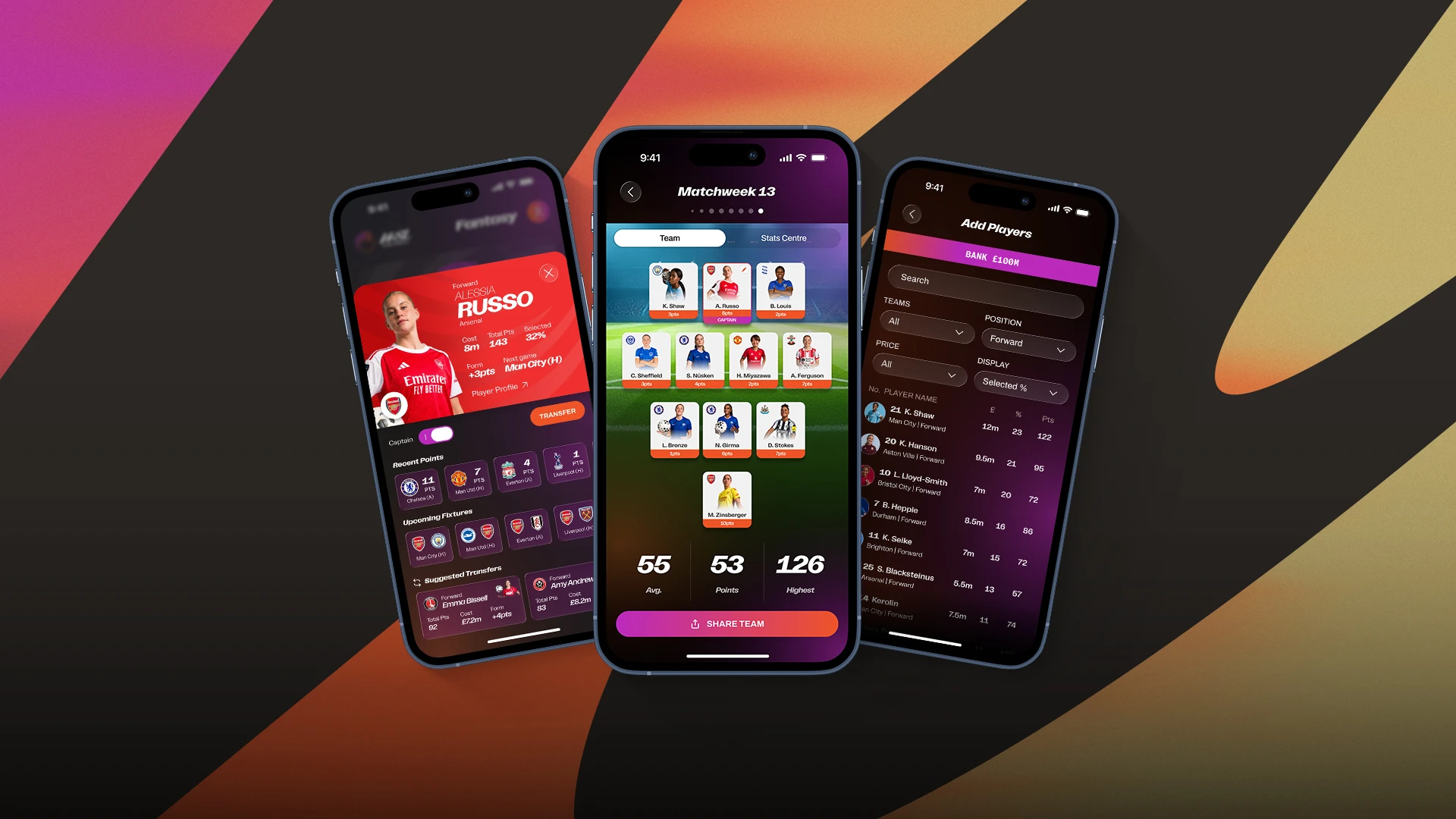
WSL Football returns on September 4 and this time, with a very welcomed addition, an official fantasy football game.
This official game, hosted by WSL Football, is by no means a copy and paste of every other fantasy football game we have played in the past. While the rules may take some getting used to, I think I quite like this new gameplay. It’s exciting, and as a fan who has not quite taken in WSL2, I think this game presents an opportunity to explore a different league.
The new game allows managers to select players from both the Barclays WSL and Barclays WSL2. It is also split into a six-Leg structure across the season, allowing managers to compete across the entire season while also enjoying some built-in shorter competitions. This definitely creates room for some interesting strategic decisions around transfers, Wildcards, Free Hits and squad construction.
This beginner’s guide is therefore not a step-by-step guide on which players you should select. Instead, it aims to answer a more interesting question: how can fantasy managers use these new rules and this new format to build a fantasy squad that can (hopefully) outwit their rivals?
Here are some questions that we should all consider before Matchweek 1.
WSL, WSL2, or both?
This is potentially the biggest question you should be asking yourself. Potentially for the first time ever, managers are not restricted to one competition. Every player from the Barclays WSL and Barclays WSL2 sits in the same pool, with managers free to select exclusively from one league or combine the two. The only restriction is that you cannot select more than three players from the same club.
This immediately creates three possible approaches, which could be daunting for some managers, especially if we are accustomed to watching one particular league. A manager could build a predominantly WSL squad, relying on familiarity and elite players. You could go heavily into WSL2, looking for value and players who may dominate their respective teams. Or you could build a genuinely combined squad, using both divisions to search for the best value across the entire player pool.
There is no obvious right answer before the season begins. Or is there?
It is important to note that players do not receive fewer points because they play in WSL2. The scoring system is the same across both leagues. A goal scorer from Chelsea and a goal scorer from Bristol City will receive the same points for the same action.
The question is therefore not which league has better players but where can managers find the best combination of fixtures, value and potential points? It could be that a high-profile WSL player is competing for a place in your squad with a WSL2 player who is involved in almost every chance her team creates.
Due to the no more than three players per club rule, even managers who want to heavily target one particularly strong team will eventually have to look elsewhere to make up the rest of their squad.
Great player, poor fantasy football asset?
This game’s scoring system is particularly interesting. Players obviously score points for goals, assists, clean sheets and minutes played. However, the real gold mine might be in the involvement points.Players can earn involvement points through shots on target, key passes, successful crosses and dribbles, as well as defensive actions such as tackles, interceptions, clearances, blocks and recoveries.
There is also no cap on the number of involvement points a player can earn in one match. And this is where I think fantasy managers need to look beyond the obvious.
Take Khadija “Bunny” Shaw for example. According to WSL Football, Shaw would have scored 199 fantasy points last season under this scoring system. Her 2025/26 season statistics taken from FotMob give us an idea of why. She recorded 21 goals and four assists, alongside 51 shots on target and 34 successful dribbles. Defensively, she recorded 17 tackles, two interceptions, 27 clearances, one block and 49 recoveries. She also avoided yellow and red cards. Bear in mind that these are season-long numbers, rather than per-match figures. However, they highlight a very important point. There are different routes to points in this game, and managers should be looking beyond the mere goal and assist.
Rather than only asking, who is most likely to score, managers should ask themselves, who else can get me points? This can make certain players more attractive picks. An attacking full-back who regularly progresses high up the pitch could have opportunities to accumulate attacking involvement while also benefiting from defensive actions and potential clean sheets. A midfielder who creates chances, takes shots and is heavily involved in possession could also have several routes to points, even when she does not score or assist.
Players from less dominant teams should not be discounted either. A defender who spends much of a match making recoveries, interceptions and tackles could still score useful points, even when her team concedes and loses the clean-sheet points.
The key could be finding players who can consistently reach the involvement thresholds, rather than relying on a player to score one goal every week. While a goal is great, a player who can keep accumulating points even when she does not score could be even more valuable.
Bonus Points Magnets
The top three performers in every match receive bonus points. Again, this means that managers may want to think beyond goal scorers. To get ahead, managers need to figure out where they can score points outside of goals and assists. Additionally, how can their defenders and goalkeepers add value to their team in the case of a clean sheet wipe out? In the grand scheme, earning an additional 3 points in one game may not seem like much, however, over 26 matchweeks, those points can add up. Hypothetically, if a manager was to have a player who earned 3 points bonus every single gameweek, that’s an additional 78 points on top of points earned for minutes played, goals, assists, and involvement contributions. In this way, a player who dominates a match without scoring could still become a very valuable fantasy asset if her overall performance regularly puts her among the best performers. One can also theorise that bonus points and involvement contributions may go hand in hand, as a player who was heavily involved in a match, already earning them involvement points, can also have more opportunities to pick up bonus points as well.
Khadija “Bunny” Shaw vs Alexia Putellas
Now let’s get to the real pre-season debate, and there’s an easy answer if you ask me. Some players are simply difficult to ignore because of their historical performance.
Khadija “Bunny” Shaw. Need I say anymore? Shaw has just had another ridiculous season. In 2025/26, she scored 21 WSL goals in 22 appearances, won her third consecutive WSL Golden Boot, and helped Manchester City win the WSL title. Two time PFA Players’ Player of the Year winner, one of the most prolific forwards in women’s football, Shaw is an obvious fantasy attraction for good reason. Shaw would have been the highest points earner last season with 199 points. That alone makes her very difficult to ignore and with those stats, I do not understand why any team would go without her. Her price matches her pedigree, coming in at £12.5m, making her the most expensive player in the game.

Then there is Alexia Putellas. Putellas is a two-time Ballon d’Or winner, the first woman to win the award twice consecutively, a World Cup winner with Spain, a four-time UEFA Women’s Champions League winner, and one of the defining players of Barcelona’s golden era. She left Barcelona this summer after 14 years, having won 38 trophies with the club, and now makes the jump to the WSL with London City Lionesses.
Putellas is not arriving in England off the back of a quiet final season. In 2025/26, Putellas helped Barcelona win another Champions League title and was named UEFA Women’s Champions League Player of the Season, finishing the Liga F competition with nine goals and seven assists. There is really no need to ask whether Putellas can kick it in the WSL. For someone of her pedigree, that question feels almost disrespectful.
The question then becomes, which one of these players will find their way into your team? Or will managers spend more than one-fifth of their £100m budget spent on two players, and how will they build a balanced squad around these players.
The Leg system: think beyond Matchweek 1
The most distinctive feature of the game is its division into six legs. Managers compete in both a season-long table and a separate table for the current leg. When a new leg begins, the leg table resets, while your squad, budget and season points continue. At the start of each leg, every manager receives free transfers which also allows managers to make unlimited transfers and create a team best suited for that competition phase without sacrificing points. In essence, it’s a wildcard every couple of weeks, without losing one of your three boosters. This creates an interesting way to approach squad building. The first leg of the season takes place between matchweek 1 to matchweek 5. Managers can build a squad that heavily focuses on the first two matchweeks, then use their free transfers saved for the next two matchweeks, and receive free transfers to reset their team after matchweek 5. That’s a lot of room for changes without damaging your total points earned.
The question therefore is not which players do you want for the entire season but which teams and players do you want to target for the current leg? Rather than constantly chasing last week’s points, managers can look at the upcoming fixtures and build towards a particular run.
In addition to this leg system, it is also important to look at the WSL and WSL2 calendar. The Barclays WSL plays across all 26 matchweeks, while WSL2 plays 22 rounds. There are six matchweeks MW6, MW8, MW11, MW12, MW15 and MW26, where only one competition is played.
Managers have one Wildcard and two Free Hits to plan for these or any other gameweek. It is worthy to note that in addition to these blank gameweeks, there are some gameweeks where players may play twice. These boosters can be used to strategically avoid missing out on potential points.
Managers who heavily build their team around one competition, would definitely need to think ahead in preparation of these matchweeks. A combined squad may provide more flexibility throughout the season, however, it can leave teams exposed if a large portion of the squad is out for a matchweek.
So, what is the best WSL Fantasy Football strategy?
No one can truly know the best strategy at the beginning of a new game. My overall advice is to select a fairly strong team with good fixtures for the first two or three weeks. Leave a little something in the bank to give yourself some wiggle room if you need to make changes and ensure you pick a good captain who will start. Most importantly, remember that fantasy football is a season-long game. Matchweek 1 is just the start that gives us the much-needed data to make better decisions later. We will start to see which players consistently pick up involvement points, which defenders offer value beyond clean sheets, and which WSL2 players stand out among their WSL counterparts.
Happy fantasy planning, and may the odds be ever in your favour.