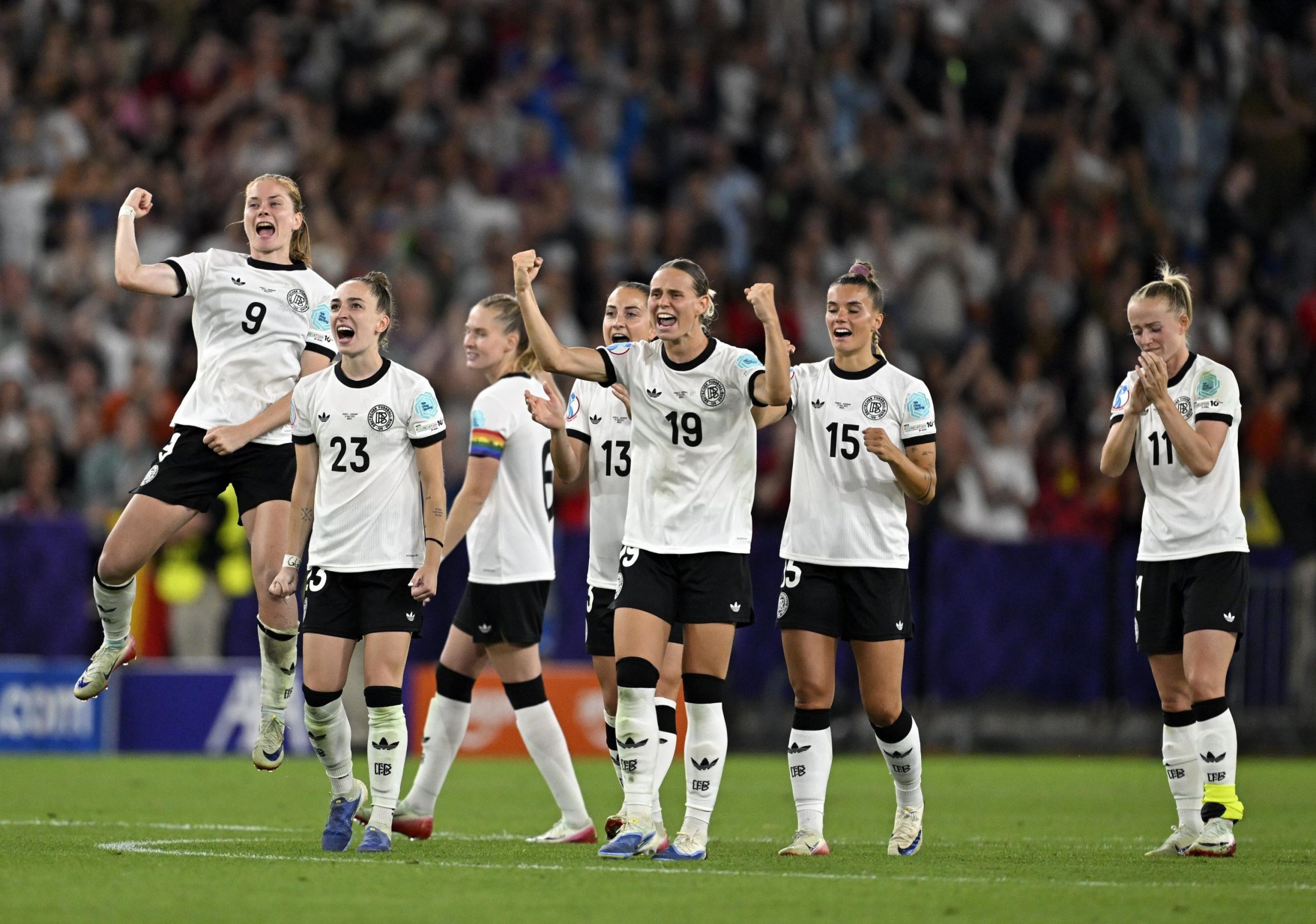
The German national team was the first European team to qualify for next year’s Women’s World Cup in Brazil. They finished first in Group D with 16 points, four points ahead of Norway. The only points they dropped came in a goalless draw against Austria.
On paper, it is another successful qualifying campaign for a nation that is known for its success. But although they are one of the most successful sides, their journey has not always been straightforward.
A history that carries weight
From 1955 to October 1970, organised women’s football was banned under the DFB. After the ban was lifted, the first national team wasn’t established until 1982. The newly formed side played its first match in November of that year. West Germany played Switzerland and won 5–1.
What followed was an extraordinary rise.
Over the years, Germany went on to win two World Cups, eight European Championships, as well as one gold and four bronze medals at the Olympics. In the Nations League, Germany finished third in its first season, 2023–2024, and second in 2024–2025.
They are also currently placed third in the FIFA world rankings.
With a history and a ranking like that, there will always be expectations.
Between two worlds
The greatest challenge for the current generation is to find its identity between the weight of Germany’s extraordinary past and a rapidly growing women’s game, where more nations are investing, and more players are playing at elite clubs.
And the 2023 World Cup probably showed best that something needed to change. They entered the tournament as a team that was favoured to take home the trophy, but ended up exiting after the group stage, collecting just four points in Group H.
At the Euros last year, they did better. They reached the semi-finals, where they lost against the current world champions, Spain.
The player who represents Germany’s legacy best is Birgit Prinz. She holds Germany’s record for appearances and is also the nation’s top goalscorer. In the 214 games she played, she scored 128 goals.
The next chapter
Now it is time for this generation of players to prepare for the upcoming World Cup.
This international break provides the team with two high-level tests. Germany faced Australia on Friday, securing a 4-2 win, and will be facing Japan on the 13th of October.
Australia bring athleticism, intensity and a growing reputation as one of the strongest teams outside Europe. In Friday’s game, Germany showed both their attacking quality and areas that they need to work on, for example, their di^iculty maintaining control of the game, particularly after conceding just before half-time.
Nonetheless, the game provided some memorable moments. While Melissa Kössler and Camilla Küver scored their first goals for the senior national team, Lisa Baum made her debut after coming on at half-time.
Japan will o^er a technical style that has long posed di^iculties for European opponents. These games are opportunities to show where the team stands.
The international break so far has also been notable for the players involved. Several changes had to be made after the initial announcement because of injuries and illness, which led to an updated squad list being published on their social media just a few hours before the Australia game.
The most notable call-ups were Lisa Baum and Luzie Zähringer. Baum received her first call-up to the senior national team at 19, while Zähringer earned hers at just 18.
Zähringer was called up following the withdrawals of Bibiane Schulze Solano, Selina Cerci and Larissa Mühlhaus.
The other players who had to withdraw from the squad were Giulia Gwinn, Vivien Endemann and Lea Schüller, with Sarai Linder, Nicole Anyomi and Shakira Martinez called up as replacements. Christian Wück also has to miss out on Kathrin Hendrich and Rebekka Knaak, who are both injured. Meanwhile, Ann-Kathrin Berger is sitting out following discussions with the coaching sta^.
While every change to the squad means a player has to miss out, it also creates opportunities for those called up as replacements to show the coaching sta^ what they’re capable of and prove they belong at this level.
The past tells us all about the golden generations. The trophies. It tells us where the expectations come from.
This generation’s challenge is to create something of their own, to find their own identity. And this challenge has already begun.