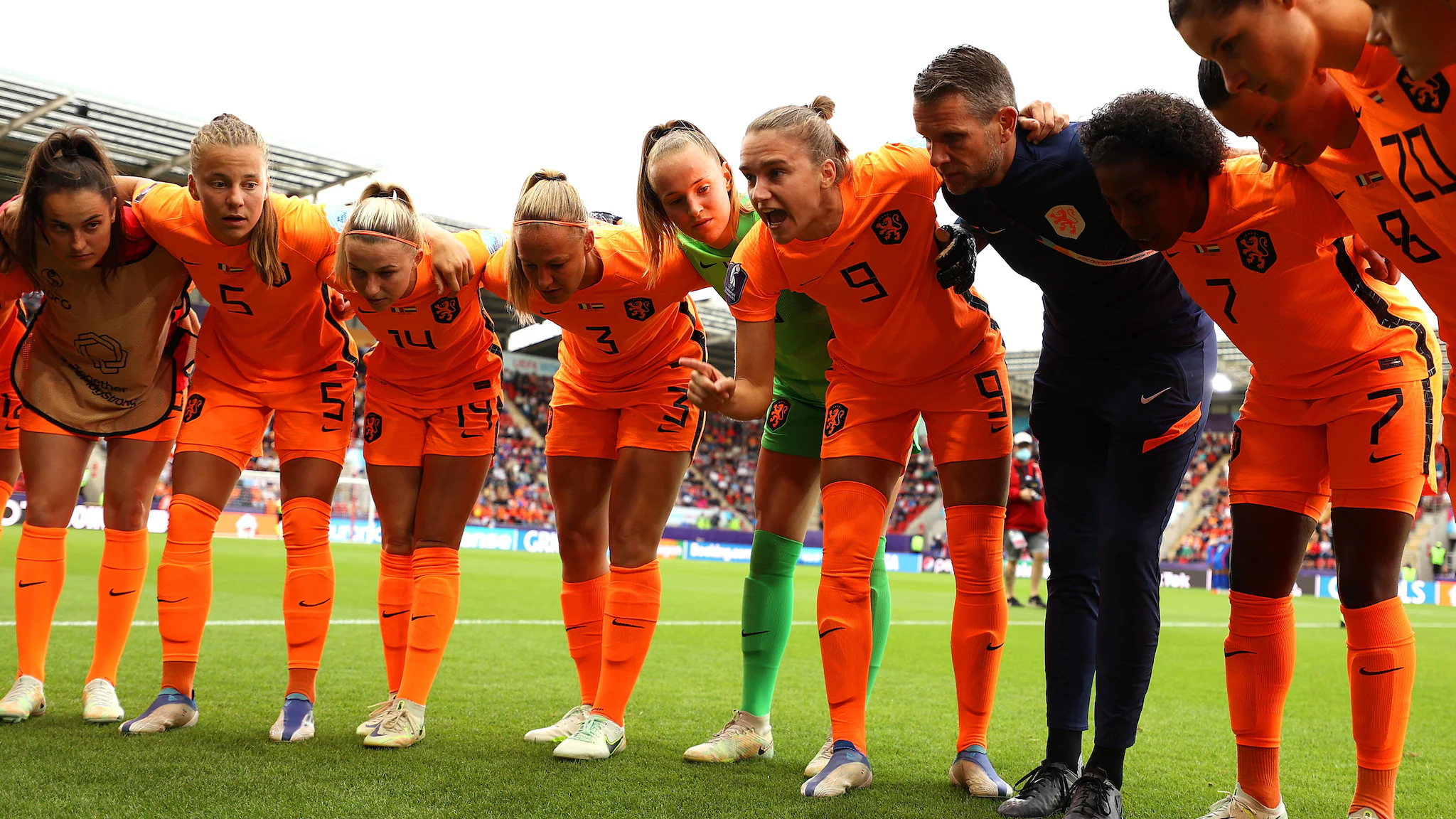
The Netherlands’ women’s national team, better known as the Oranje Leeuwinnen, have become one of the most recognisable teams in European women’s football. From their historic European Championship triumph in 2017 to reaching the 2019 FIFA Women’s World Cup final, the Dutch have established themselves as regular contenders on the international stage. Now, however, they face a crucial test on the road to the 2027 World Cup in Brazil.
The Netherlands did not secure one of UEFA’s four direct World Cup qualification places. They finished second in Group A2 behind France, collecting 11 points from six matches. Their campaign included a 2-1 victory over France, a 1-1 draw away to the French, wins over the Republic of Ireland and Poland, but also a disappointing 3-2 defeat in Ireland. The result against Poland on 9 June confirmed that the Dutch would have to go through the play-offs rather than qualify directly.
That mixed qualifying campaign reflects a team that is still very competitive, but perhaps not quite as dominant as they were during their most successful years. In their six qualifying matches, the Netherlands scored 12 goals and conceded nine. They have shown that they can compete with the strongest European opposition, but consistency has been an issue.
A history of high expectations
The expectations surrounding the Oranje Leeuwinnen are partly the result of how quickly the team rose to the top of European football. Their breakthrough came at UEFA Women’s EURO 2017, when they won their first major international trophy, on home soil. In a memorable final in Enschede, the Dutch defeated Denmark 4-2, with Vivianne Miedema scoring twice.
Two years later, the Netherlands went even further at the 2019 World Cup in France. They reached the final for the first time, defeating Sweden 1-0 after extra time in the semi-final before losing 2-0 to the United States in the final. It was only the Netherlands’ second appearance at a Women’s World Cup, making the achievement particularly significant.
The following international tournaments have been less spectacular. At the 2022 European Championship, the Dutch reached the quarter-finals, while they again made the last eight at the 2023 World Cup, where Spain eventually eliminated them after extra time. UEFA therefore described the Netherlands as a team with considerable pedigree going into EURO 2025.
That tournament was more difficult. The Netherlands opened the tournament impressively, beating Wales 3-0, with Miedema scoring her 100th international goal. However, heavy defeats followed against England and France, 4-0 and 5-2 respectively, and the Dutch did not even reach the knockout stages.
The players to watch
Despite those setbacks, the Netherlands still possess considerable individual quality. At the heart of the attack is Vivianne Miedema, one of the defining players of Dutch women’s football. Her experience and goalscoring record remain central to the team’s ambitions, while younger players are increasingly taking on important roles. With Miedema’s recent injury history however, it remains to be seen how much of an impact she can make in the upcoming months.
One of the most exciting emerging players is Renee van Asten. The 19-year-old Barcelona defender made her international debut in April 2026 against France and immediately made an impact, scoring the opening goal in a 2-1 victory over one of Europe’s strongest teams. Van Asten has since remained part of the national team setup, making her one of the younger players to watch as the Netherlands enter the decisive stage of World Cup qualification.
Esmee Brugts is another important attacking option, offering pace and creativity from wide areas. She scored the winning goal against France in April and has continued to play an important role during qualifying. Experienced players such as Dominique Janssen and Daniëlle van de Donk add leadership to the squad.
With players such as Van Asten and Brugts representing the next generation alongside established names like Miedema and Groenen, the Oranje Leeuwinnen have a mixture of youth and experience to rely on as they attempt to secure their place at the 2027 World Cup.
Pressure and opportunity
For Dutch supporters, the play-offs carry considerable significance. The Oranje Leeuwinnen are not simply trying to qualify for another major tournament; they are trying to maintain their place among Europe’s established elite.
Their recent form suggests that qualification will not be straightforward. At the same time, the team has already demonstrated in 2026 that it can take points from France and produce convincing victories when required. The Netherlands currently sit tenth in the FIFA women’s world ranking, having previously reached as high as third.
The expectation from fans is consequently clear: Oranje should be competing at the World Cup. But their recent results also suggest that reputation alone will not be enough. The play-offs will demand consistency, defensive solidity and contributions from both the experienced stars and the emerging generation.
The Netherlands’ next challenge is against Hungary on 9 October 2026. If they beat Hungary in a two-legged match-up, the Leeuwinnen will either face Turkey or Slovenia in November. For the Oranje Leeuwinnen, the route to Brazil is still open, but after years of deep tournament runs, the pressure to make it there has rarely felt greater.